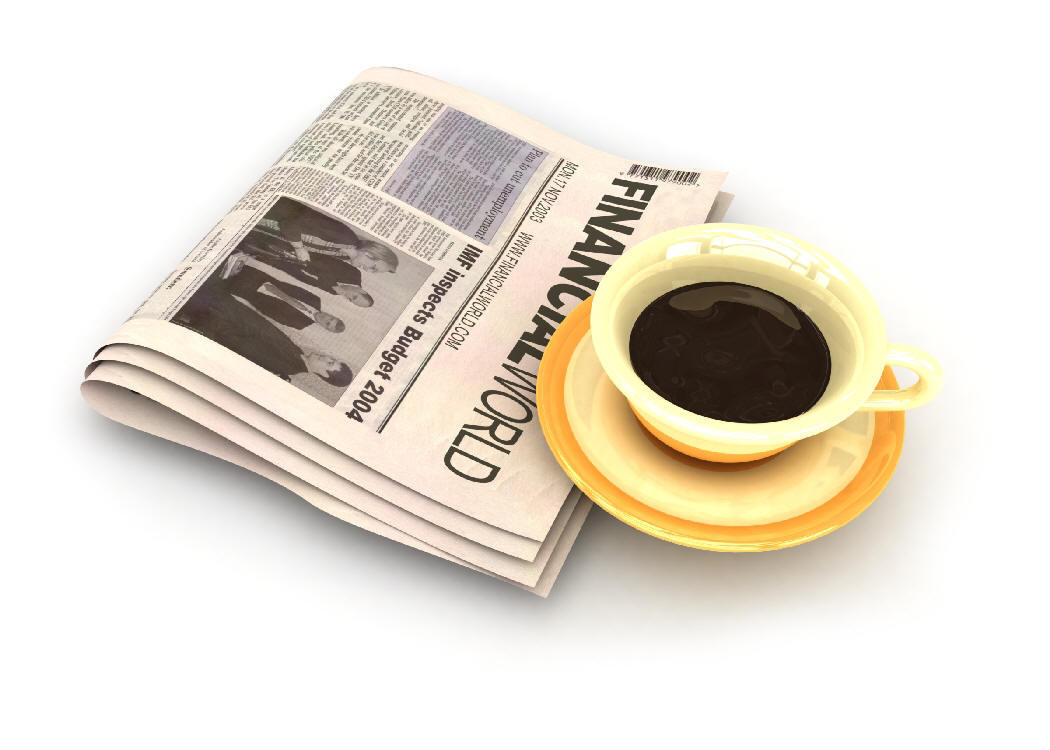
| 11 W.
30th Street |
|
| 1960s- 1970s. There is very little
information about this company. It is believed that they were
one of the companies that sold kits to the public. Some of the
jewelry is unsigned while others are signed. I think that fact
leads to the speculation that the crafted by the public pieces
might be the ones without the hallmark. I am not sure.
This hallmark is relatively rare. If the piece is signed that is
obviously a plus. The signed pieces are becoming quite
collectable. |
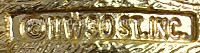 |
| 1928 |
|
| California. Founded by Melvin Bernie and Veta
Nelson. Began making costume jewelry in 1968. Still a family run
company with a current website. Jewelry is usually ornate with a
Victorian look. The back are almost as pretty as the front in
most cases. It is possible to find unsigned pieces that
were originally on cards or had a hang-tag. |
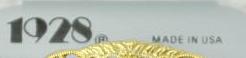 |
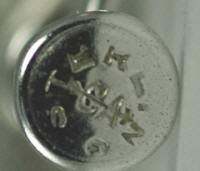
| A&Z |
|
| Founder (s): Carl
Anshen and Saul Zietlin - Providence RI, USA 1905 as the A&Z
Chain company. Somewhere along the way this company became part
of the Hayward Company.
Back to top |
 |
|
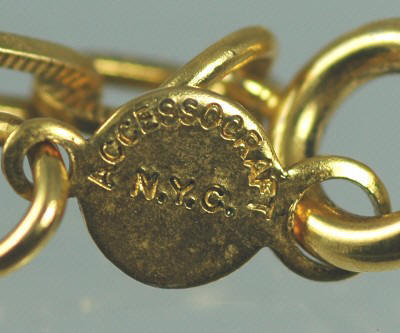
Accessocraft |
|
| Founder (s):
Edgar Roddheimer and Theodore
Steinman 1935-1998 NYC as the Accessocraft Products
Co. Both of these gentlemen worked as salespeople for
Monocraft, now known as Monet! Theodore's son Paul ran the
company until it closed. Several design firms such as Anne Klein
contracted with the firm to produce their designs because of the
reputation Accessocraft had for quality workmanship.
Signature Designs: WWII relief pins, opera glasses,
magnifying glasses, buttons, buckles. Their jewelry was bold and
innovative.
Back to top |
 |
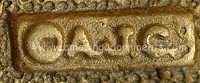
| AJC |
|
American Jewelry Chain Company ~ Late 1920s
to late 1990s. Cute figural pins some with stones.
Back to top
|
 |
| AJMC |
|
| American Jewelry Manufacturing Company |
|
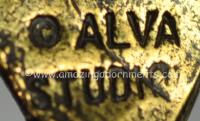
| Alva Studios |
|
New York. Known for producing high quality
museum reproductions.
Back to top
|
 |
|
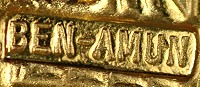
Ben Amun |
|
| Founder: Isaac Manevitz
- Born in Egypt and has a showroom in NYC. His bold and trendy
jewelry can be seen in fashion magazines and on several
starlets. He has designed for Ralph Lauren and Calvin Klein. He
has been designing jewelry for over 30 years. Has current
website.
Back to top |
 |
|
James Arpad |
|
High end jewelry is made of the
best crystals set pave style. He also produced a line of evening
handbags with Luc Benoit. He also designed a line of beaded pins
for AIDS charities.
Back to top
|
 |
|
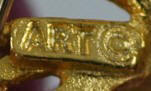
ART
|
|
| Owner:
Arthur Pepper -I have seen
different dates for their production 1940s- 1960s and
1950s-1980s -Also known as Mode Art Company, they
produced medium to high priced costume jewelry under the
name Art Mode Jewelry Creations, Inc. Figurals and
especially fine
Victorian and
Art Deco replicas were among some of their finest work.
Materials and techniques included: Carved plastics,
clustered rhinestones, enameling and beautiful filigree work.
Jewelry that resembles that of Florenza.
Back to top |
 |
|
Atlas |
|
|
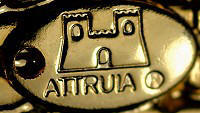
Attruia |
|
| Anthony Attruia- Providence RI
~ Known for fabulous Christmas tree pins made with handset
Swarovski rhinestones and crystals. Back to top
|
 |
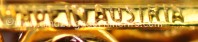
| Austria |
|
| Jewelry marked Austria or Made in
Austria can be found at the high end and the lower end. Most of
the higher quality pieces incorporate the highest quality
stones. Jewelry has been imported from Austria for decades. In
the early 1900s the pieces were mostly made from crystals. Two
collector favorites are the fruit pieces and the forbidden fruit
pieces. Back to top |
 |
| James Avery |
|
|
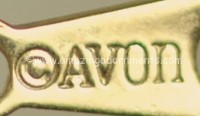
Avon
|
|
At the age of 28, David H.
McConnell began a company named the California Perfume Company.
The company's first color catalogue was produced in October of
1906. By 1928 there were 25,000 reps selling the companies
products. In 1939 the company changed it's name to Avon
Products, Inc. The first products offered were vanity sets, a
toothbrush and talcum. In 1954, Avon began it's wildly
successful "Avon Calling" ad campaign. The company moved
overseas for the first time. In 1971, Avon began to market
costume jewelry. Avon jewelry was produced by other designers
such as Kenneth J. Lane. Still in business today.
There is an ongoing discussion as to whether the certain
hallmarks associated with this company are actually hallmarks
belonging to Avon of Belleville.
Avon of Belleville is a
Canadian company. More on this later.
Back to top
|
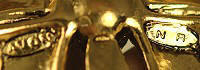
Thought to be Nina Ricci for Avon.
Have been told this could be Avon of Belleville and not Nina
Ricci. I can't say at this point. 2/2010 Update: The NR is
most likely not for Nina Ricci.
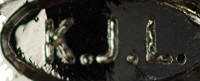
This mark was found on KJL
for Avon Earrings. The earrings are also in an Avon box. Newer
[2000] hallmark
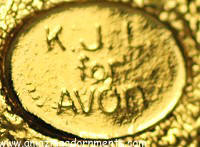
1986- 1995 hallmark
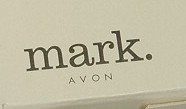
"Mark." for Avon - A New Line
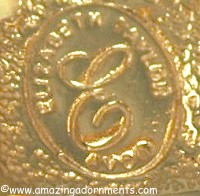
Elizabeth Taylor for Avon 1993- 1997
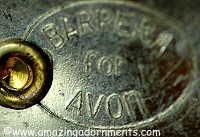
Jose Barerra for Avon 1989 -Mid 1990s
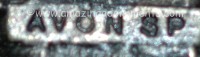
This mark is from a 2007 piece |
| Avon of
Belleville |
|
| 1945 to early 1970s. This company is
not associated with Avon Products, the "Avon Calling" company.
First, this company operated out of Canada. It was founded by a
Abe Mazer [Jomaz/Mazer Bros.]. This jewelry is of higher quality
than most Avon pieces.
Back to top |
|
|
B. David
|
|
|
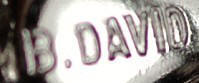
1945 - 1993? Cincinnati Ohio -B. David
company was a small company that produced costume and fine jewelry. Their
output was limited. This company produced a famous crown pin that is a
collectors favorite. Follow
the link above to visit the B David Gallery to see the crown. Signature Designs: Pretty,
high quality rhinestone combinations, dainty jewelry.
Back to top
|
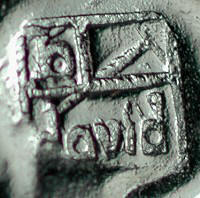
 |
|
Banana Bob |
|
|
Annie Venditti - Former professional level
figure skater. Creative jewelry that sold in better department stores.
1980s-1990s. Highly collectable. Various styles included Art Nouveau, Deco
and Victorian. Metal elements often vintage. Crystals and rhinestones were
top quality. Back to top |
Usually on a card or with paper hang
tag. |
|
Barclay
|
|
|
Founders: Alvin Rice, Robert Rice
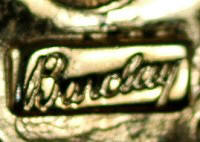
and Louis Mark-1946 -1957, Providence RI-This was not jewelry produced by McClelland
Barclay which is very expensive and will have the full signature as a
hallmark. Barclay first used a hallmark in 1948.Signature Designs: Rhinestones in
colors [very often blue] set in gold tone metal.
Back to top
|
 |
|
McClelland Barclay |
|
|
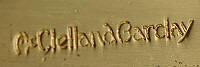
Founder (s): McClelland Barclay 1935
- 1943 -Many jewelry sleuths have spent time trying
to decipher the connection if any between this maker and
Barclay. the confusion begins with the company Rice- Weiner. Rice-
Weiner made and stocked costume jewelry for McClelland Barclay and others including
Korda. One of the former owners after leaving Rice- Weiner started Barclay.
This confusion continued with what some
call the deliberate stamping of similar hallmarks on both companies jewelry.
McClelland Barclay was more than a jewelry
designer. He was an esteemed painter and an illustrator. He was born in St.
Louis, Missouri in the late 1800s. He studied at several art schools and
went on to have his work featured in several magazines. During the 1920s and
the 1930s he became world famous for his
Art Deco jewelry. In 1943, while aboard a ship during WWII,
he lost his life. His fine creations live on! The jewelry is rare. He worked in sterling
during 1942 and 1943. The hallmark never appeared on a raised
plaque. Techniques/Signature Looks:
Sculptural Art Deco jewelry, sterling silver.
Back to top |
 |
|
Dorothy Bauer |
|
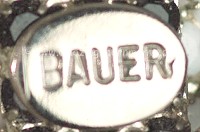
Founder (s): Dorothy and
her husband Robert Bauer. Berkeley, CA, USA
~ 1982 ~ Present. Has current website. Known for cute as can be
sculptural jewelry made from high end colored and clear faceted crystals. Her
father owned a jewelry store and although she wanted to become a
sculptor, she opened her first jewelry shop in 1981. Prior to
this she sold hand blown glass jewelry. Her pieces are all
mostly hand constructed.
Back to top
|
 |
|
Erickson Beamon |
|
Founded by Detroit natives Karen Erickson and Vicki Beamon in
the early 1980s. Moved to New York in 1982. Began designing
jewelry after needing jewelry for a fashion show. Their
jewelry is made from the best crystals and natural gemstones.
The also work in gold and in 2003 they introduced a diamond
collection. They have created for some of the best designers in
the business including Dior, Chanel and Givenchy. Many
celebrates wear their pieces including Jennifer Lopez,
Alisha Keys, Angelina Jolie, Madonna, Beyonce, Paris Hilton,
Rihanna and Michelle Obama to name a few. Best known for their
hand beaded necklaces.
Their jewelry sells at better department stores including Saks
Fifth Avenue. They did a very limited run for Target from
February 2009 to June 2009.
Back to top
|
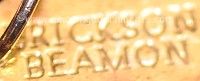
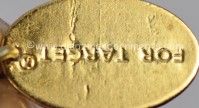
The pieces for Target say
"Erickson
Beamon"
on one side of the hang-tag
and "For
Target®"
on the other.
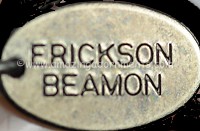
Private Line- Not for Target
Erickson Beamon line is signed Erickson
Beamon on one side with a plain second side of the hang-tag.
 |
|
Beatrix |
|
1946- 1983 Nat Sugarman Rhode Island ~ This company is well
known for holiday jewelry. They created it for other companies
including Walt Disney, as well as themselves. During the 1960s
the company was sold to the manager, Leonard Mandell. Mr.
Mandell sold it to another company in 1975. The BJ mark was
first used at that time.
The company closed in 1983.
Back to top
|
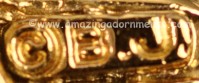
Also Beatrix which we believe
is an earlier mark. |
|
Beau Jewels
|
|
|
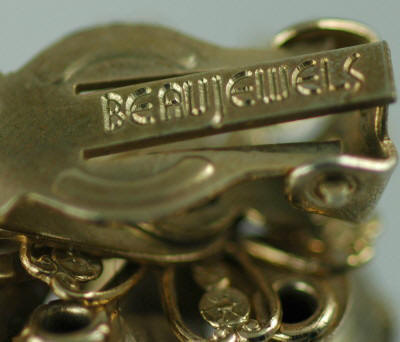
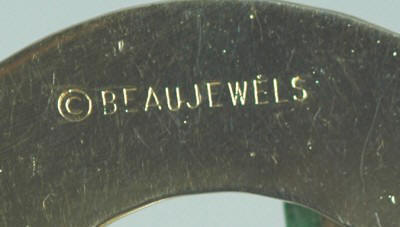
1950s - 1970s? -This is a little sketchy. I have read that
the name Beau Jewels was used by Bowman Foster. This mark should not
be confused with pieces marked
Beau Sterling/Beaucraft. Beau Jewels only signed the earrings when
they were part of a set. Signature Designs: Pretty
color combinations, large brooches, filigree and rivet construction.
Back to top
|
 |
|
Beau Sterling
[Aka Beaucraft] |
|
|
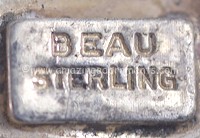
1944-? Providence RI. As
of 2004 they were still in business. I goggled their web site and their
domain is not registered any longer. I believe they are not in
business at this time and I have read that they sold their molds! Trademark- BEAU-Producers of sterling silver jewelry. Signature Designs: Quality
sterling jewelry.
Back to top
|
 |
|
Kenneth Begay |
|
Native American/Original People/Indian: Navajo
silversmith. World renowned and has been called the
Father of Modern Navajo jewelry. He worked independently
and also worked for White Hogan during the 1950s. He also taught
silversmithing at a university in Arizona and he taught his own
son Harvey the art. Kenneth Begay's jewelry is known for clean
lines.
Back to top
|
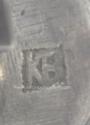 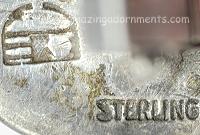 |
|
|
Another hallmark according to the
book Hallmarks of
the Southwest is
the "KB" with fringed edges. |
|
Bellini |
|
Used by the Formart Jewelry Company, New York since 1988. They
also do business as Bellini Creations.
Back to top
|
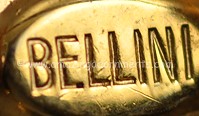
Also Bellini by Formart |
|
Edgar Berebi |
|
1981 - New York~ Has current
website showing very elaborate picture frames and objects for
the home. Focused on jewelry until the early 2000s. The older
jewelry was not marked. Some can be found with paper stickers as
labels.
Back to top
|
 |
|
Bergère |
|
|
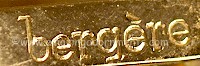
Founder (s): Herbert & Pohs, Inc., New York City. In
operation from 1946 to 1979 -The company had a Providence R.I. office.
Their medium to high quality costume jewelry sold at stores such as Lord & Taylor.
Signature Designs: Known for
their "real" looking costume jewelry. Medium to high quality costume
jewelry.
Back to top
|
 |
|
Les Bernard
|
|
|
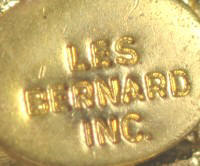
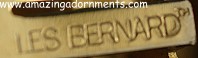
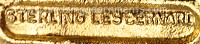
Founder [s]/Owner [s]: Bernard
Shapiro and Lester Joy ~ Early 1960s- 1996 -The trademark Les Bernard is a
combination of the founders names. Bernard Shapiro is the son of another
well known costume jewelry maker, Harold Shapiro founder of
Vogue Jewelry
Company. Their pieces were innovative, utilizing techniques not seen
before in costume jewelry. Les Bernard made jewelry for others. Materials and techniques included:
Quality pieces using techniques not tried before such as the setting of
flat backed marcasites and rhinestones in the same item. Combining
different shapes and stones. Sterling. The use of fabric, crystal and enamel.
Back to top
|
 |
|
Fred A. Block |
|
|
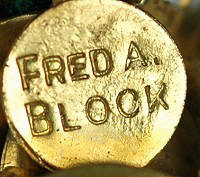
Founder (s): Chicago IL, USA ~1930s -
1950s- As you can see by the above dates, the
company was not in business for long. A showroom was opened in Chicago in the
early 1940s on the second floor of the Merchandise Mart according to an ad
shown in the book A Tribute to America by Carla and Roberto
Brunialti. At least one piece of Block jewelry was
designed by Sandor Goldberger. Signature Designs/Techniques:
Quality pieces made with top of the line rhinestones. Enamel pieces,
plastic.
Back to top |
 |
|
Bogoff
|
|
|
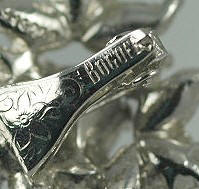
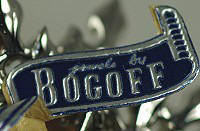
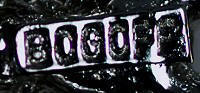
Founder (s): Henry and Yvette Bogoff
founded the Spear Novelty Company, Chicago, IL in the 1920s. They produced
buttons and other items. Jewels by Bogoff began in 1946 to the 1960s -Together Henry and Yvette ran a successful
jewelry company that was able to compete with other premier jewelry
companies of the day. After Henry died the company was moved to New York.
Copyright symbols do not appear on Bogoff
jewelry. Signature Designs: Distinctive chain, rhodium
finished metal, silver tone metal, small rhinestones, pave set stones,
leaf designs.
Back to top
|
 |
|
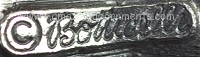
Bottecelli |
|
|
Providence RI
Back to top
|
 |
|
Boucher
|
|
|
Founder (s): Marcel Boucher 1937
-1971
Marcel Boucher got his training from the
best! He trained with Cartier while living in his birthplace of France.
He then went to work for Mazer Brothers before deciding to open his own
company. Marcel married his assistant Sandra Semensohn. Sandra designed
watches for Marcel Boucher. She continued to run the company after his death
in 1965. She also designed jewelry and was issued several patents. Eventually the company became a subsidiary of Dovorn Industry a
watch maker.
Design numbers
accompanied the hallmarks on most Boucher costume jewelry. These numbers
while helpful in trying to identify a date for your Boucher piece, they are
not etched in stone.
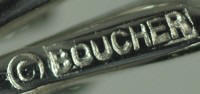
Some Boucher hallmarks include: MB, Marcel
Boucher,
Marboux, Boucher,
Parisina [used for sterling made in Mexico] and
Earrite. MB is one of the earliest marks. Usually this mark was
accompanied by the
Phrygian Cap. This mark is
taken from the helmet worn by the French during the Revolution. There is
some diverging opinions on when this mark was used. I have seen the
following dates. 1944- 1949 and 1937- 1949.
Another mark is "Sterling" accompanying the
MB mark. The dates for this mark that I have seen are 1942- 1944.Signature Designs: Quality
rhinestones, 3D birds that appear to be flying!
FLOWER OF THE MONTH
PIECES:
JAN: Carnation
Feb: Violets
March: Jonquil
April: Pansy
May: Lilly of the Valley
June: Rose
July: Lilium
August: Gladiolus
September: Dahlia
October:
Orchid
November: Mum
December: Daffodil
Back to top
|
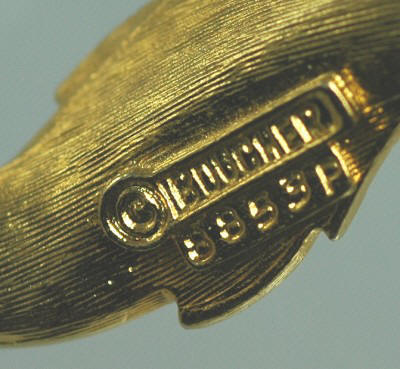
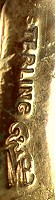 Phrygian Cap and Sterling Mark Phrygian Cap and Sterling Mark
These dates are
approximations.
|
Design Number |
Dates |
| 2300- 2350 |
1945 |
| 2351- 2450 |
1946 |
| 2450- 2550 |
1947 |
| 2550- 2750 |
1948 |
| 2750- 3000 |
1949 |
| 3000- 3500 |
1950 |

Marboux
hallmark
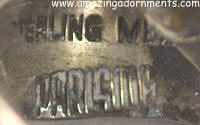
Parisina
hallmark |
|
Brooks |
|
|
Founder (s): 1960s - 1970s -Very little is known about this company. I
love a good mystery so I will keep trying to find out what I can and post it
here. It is thought that this costume jewelry was made during the 1960s and
the 1970s. The pin below is an good example of some of the pieces I have
seen. Signature Designs: Christmas
tree pins, gold tone metal, and wire work.
Back to top |
The hallmark is "©BROOKS" on a raised
rectangle. |
|
BSK
|
|
|
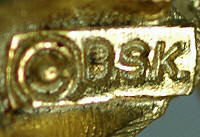
Founder (s): Benny [B]
Steinberg, Hy Slovitt [S] and Kaslo [K] - New York City-1948
to the early 1980s-BSK manufactured mid-quality costume jewelry
that was sold in department stores. Their jewelry is easy to find on the
market. There is limited information about this company. Signature Designs: Interesting
gold -tone and gold plated designs. Average quality jewelry with
enameling and rhinestones. Nice color combinations. Produced a line of
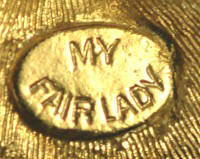
enamel and rhinestone jewelry called "My Fair Lady".
Back to top
Laurel Burch |
 |
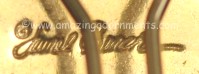
San Francisco- Born in Southern California in 1945 and passed away in 2007. Known for
colorful enamel jewelry and lovely paintings.
Some of her designs were stamped with the name of the piece.
When she began making jewelry out of necessity, she was her own
model. She would also give them away. Soon they caught on and
now they are highly collectable.
Back to top
|
 |
|
|
|
|
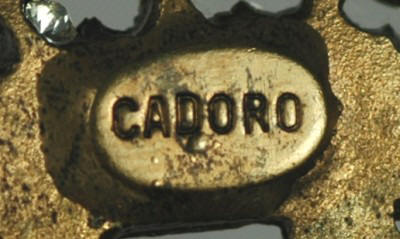
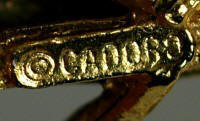
Cadoro
|
|
|
Founder (s): Dan Stoenescu
[previously thought to be Staneslieu. Thanks to Nancy Rossbacher for this
information found in Vintage Fashion and Costume Jewelry magazine, Vol. 19,
No3. 2009 on page 3.] and
Steve Brody, 1954 into the 1980s, NYC-Not a lot is known about this company.
Steve Brody was an Broadway actor. His partner was of Romanian decent and their jewelry often
reflected that bold style coupled with the glitz of Hollywood. This is high end costume jewelry that has been
said to look real. Some say it rivals the beauty of fine jewelry. Their
enameled
Christmas trees
and other holiday jewelry are highly
collectable as is most of this Hollywood inspired jewelry. Signature Designs: Hand crafted
jewelry. Big and bold
jewelry utilizing exemplary materials from all over the world. Based upon movie star jewelry
and popular with the "jet set".
Glamorous! Back
to top
|
 |
|
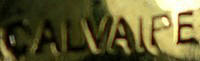
Calvaire |
|
|
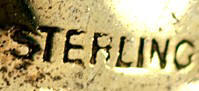
Founder (s): It was widely believed
that Ray Calish founded this company. Ray Calish is actually
Rachel C. Calish according to Ann Pitman in her book
Inside the Jewelry Box, Volume 3.
The company was founded in the 1920s. Operations
seemed to have ceased sometime during the 1960s. There was also
the thought that the company was French with divisions in the United States. Ms.
Calish was born in San Francisco and the company was founded in
New York. She did travel to Europe on a regular basis. Ann
Pitman also mentions that Ms. Calish had a partner named Stella
Aronson. The jewelry is rare, high quality and commands high prices when found.
They also sold accessories. Some of the accessories were marked
"Made in France for Calvaire".
Back to top |
 |
|
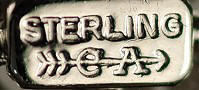
Carl-Art
|
|
|
Founder (s): Providence RI, USA 1936
or 1937 - the 1980s -This
company made sterling silver, gold over sterling and gold filled jewelry.
They also manufactured 14k gold chains at some point. Most of the jewelry
manufactured was dainty, but well made and of innovative design. Rhinestones
were used in some of the designs. There is a great article on Carl- Art in
the publication Vintage Fashion and Costume Jewelry, Vol.15, NO3, 2005. This
article was written by Cheri Van Hoover who is also a fellow member of the
Jewel Collect forum. Signature Designs: Sterling,
gold over sterling retro looks, dainty.
Back to top
|
 |
|
Hattie Carnegie
|
|
|
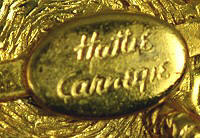
Founder (s): Hattie Carnegie 1919 -
1970s- Hattie Carnegie was another fashion
designer that made their way in the costume jewelry business. Born in Vienna
in 1886, she came to the United States with her parents when she was a
child. In 1918 she opened her fashion house in New York City. It was called
Hattie Carnegie, Inc. Like
Schiaparelli,
Chanel and others she
began to market jewelry she thought would look good with the outfits she
designed. Her costume jewelry was a favorite amongst
the actresses and socialites of the day. It was sold in some of the
department stores. Carnegie jewelry was/is expensive and very well made. Signature Designs:
Oriental figurals, animals, rhinestone jewelry, and costume jewelry with
Greek inspired motifs.
Back to top |
|
|
Castlecliff |
|
|
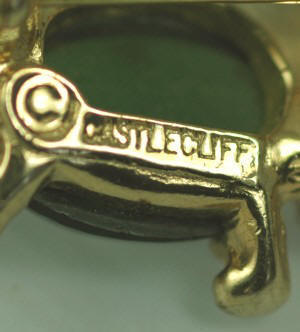
Founder (s): Clifford Burst and
Joseph Bobley in New York City. 1918 - 1977 -The first use of the Castlecliff mark was
in 1941. They also used Sterling Castlecliff and, Castlemark and Cassandra
as hallmarks. Their jewelry was well made and sold in
better department stores. In the 70s Castlecliff became part of
Carnegie Industries Co. In the 80s the company became part of Lucien Piccard
Industries. Signature Designs: Intricate
designs reflective of history. Gothic,
Art Deco
and Renaissance in
styling.
Back to top
|
 |
|
Cathé |
|
Founded in the 1960s - California. Used expensive stones
and many pieces had usual designs.
Back to top
|
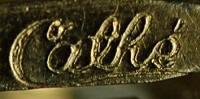
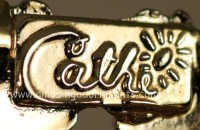 |
|
Alice Caviness |
|
| 1940s - the late 90s -Alice
Caviness began manufacturing jewelry to compliment her fashion
designs, much like Chanel and Schiaparelli. She had a abundance
of flair, garnering attention for her impeccable style of dress.
Her jewelry reflects her sense of taste. It was sold only in the
finest stores. Her company was based in Long Island, NY. Alice
Caviness designed most of her costume jewelry and was also
involved in production and sales. Her company also
produced sterling silver jewelry. She also employed two
designers, Lois Steever and Camille Petronzio. They were both
young when they joined. Lois went on to run the company after
Alice Caviness died in 1983. Camille Petronzio went on to work
at Miriam Haskell.
Back to top
|
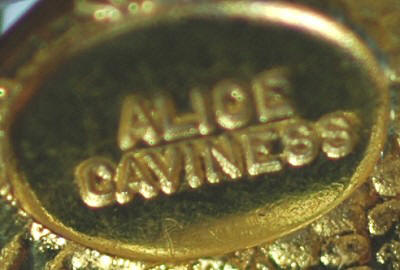
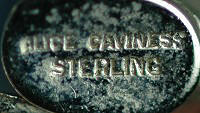 |
|
Celebrity |
|
|
Founder (s): Unclear ownership.
New York City, NY, USA. Possible dates of operation are 1950s
- 1970s -Another costume jewelry company where the
information available is sparse. It is widely believed that Celebrity
costume jewelry was sold through house parties much like Sarah Coventry
jewelry. It is possible to see unmarked pieces as
some where marked only with a paper hang-tag and if a set, only one piece
would be marked. Signature Designs/Techniques:
Silver and gold- tone jewelry, some rhinestone jewelry, mixed quality
range.
Back to top
|
Hallmarks:
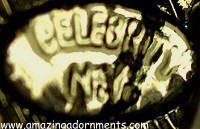
The above says Celebrity NY
Celebrity
Celebrity©
Celebrity on a Plaque
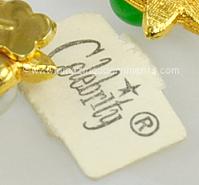 |
|
Charel |
|
|
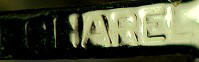
Founder (s): Charel Jewelry Co.,
Inc., Brooklyn NY, USA, around 1945-It is not known when this company ceased
operations. The jewelry is relatively rare and of medium quality. Signature Designs/Techniques:
Colored plastics including
Thermoplastic jewelry,
Art Moderne influences.
Back to top |
 |
|
Chico's |
|
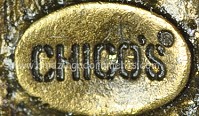
A boutique/clothier that has been in
business for about 25 years. At first they sold Mexican folk art
in Florida. They now have stores all over and a web presence.
They sell clothing with exotic and colorful prints, accessories,
and wrinkle free travel clothing.
Back to top
|
 |
|
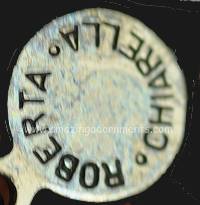
Roberta Chiarella |
|
Contemporary.
Handcrafted pieces from mostly Swarovski crystals. Has current
website. Her pieces are celebrity favorites. Some of her pieces
can also be found on HSN.
Back to top
|
 |
|
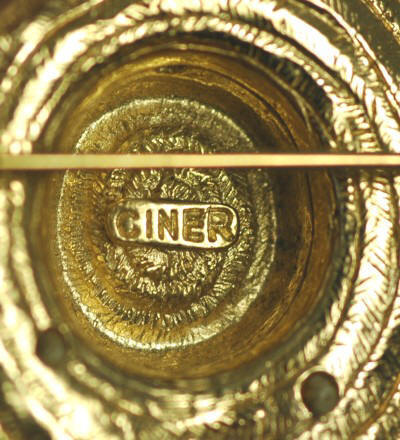
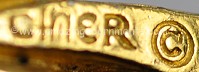
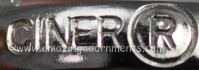
Ciner
|
|
|
Owner and Designer: Founded by Emanuel Ciner in 1892- The company began making costume
jewelry in 1931. It originally produced fine jewelry. Their jewelry has
the look of real jewelry. Ciner costume jewelry is often referred to as
the "Tiffany" of costume jewelry. Ciner costume jewelry is worn and loved by
many including the rich and famous. Still in business. Materials and techniques included:
Real looking faux pearls from Japan, high quality material including
rhinestones. Seed
turquoise beads set mostly in gold tone metal. Back to top
|
 |
|
CINI
|
|
|
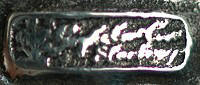
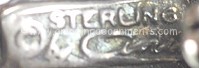
Founder (s): Guglielmo Cini, Boston,
MA, USA 1922-Guglielmo Cini was originally from
Florence, Italy. He immigrated to the United States in 1922. Cini brought
with him his talent for crafting jewelry. His early work was crafted in
sterling silver and he also created gold plated jewelry. During the 1950s
rhinestones began to appear in his work. Some of his clientele were movie stars and
his reputation grew as one of the finest master jewelers. The company moved to Laguna Beach, CA in
1957, Cini died in 1979, however his wife an an apprentice named Felipe
Mendoza continued the business. I have read that between 1970 and 1993
the company stopped producing jewelry and then started up again in 1993.
Cini jewelry is not always signed, however
once you become familiar with his style it is easy to recognize the pieces.
Signature Designs/Techniques:
Sterling silver and gold- plated jewelry. Handmade jewelry.
Reproductions of antique pieces, classical look jewelry,
repoussé,
filigree and 3-D jewelry.
Back to top |
 |
|
Claudette
|
|
|
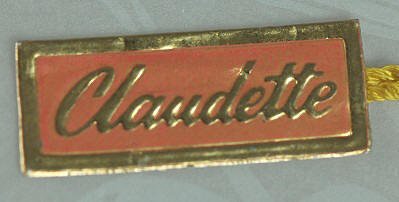
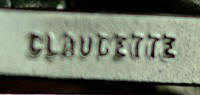
Founder (s): Possibly the Premier Jewelry Co.,
Inc., New York City, NY, USA- Claudette is thought to be the trademark of the Premier
Jewelry Company and it was first used in 1945. It is not clear when
this company ceased operations. Costume jewelry with the Claudette mark is
rare. The rhinestone jewelry is usually well made. This company also
produced plastic jewelry. The plastic jewelry is more available in the
marketplace. Some of this jewelry is marked with a paper
hang tag.
Signature Designs/Techniques:
High quality rhinestone jewelry, thermo- plastic jewelry. Interesting
shapes and colors.
Back to top |
 |
|
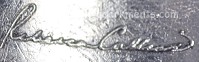
Rebecca Collins |
|
|
Originally from Texas, she began designing
one-of-a-kind jewelry in the mid- 1970s. She uses unique
material that she travels all over the world to find. She
retired in 2009. Her jewelry sold at Nieman Marcus.
She has a current website.
Back to top |
 |
|
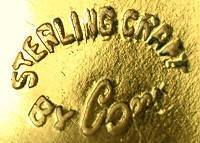
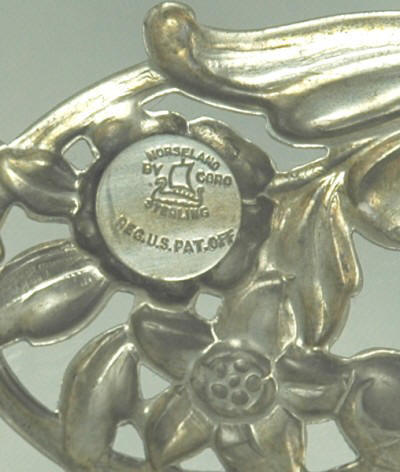
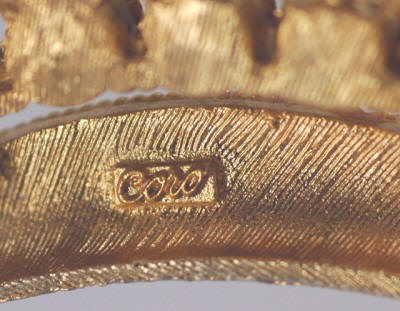
Coro |
|
|
Owner(s): Emanuel Cohn and later with Carl Rosenberger
~The name of the company is a contraction of their
last names. The history of
Coro is as long as it is compelling. There really isn't any way to do
this company justice on a single page. This brief version should be just
enough to give the reader a flavor of the very influential company.
The company was founded in New York City in 1901 by Cohn as
the E. Cohn & Company. Think back to the times, early turn of the century,
and the jewelry styles that were popular, the
Art Nouveau
period. American jewelry was still highly influenced by
European styles. The department stores in New York certainly were not paying
very much attention to what we now call
costume jewelry. Cohn had a business background. He noticed the limited
space costume jewelry garnered at the stores. In 1903 he teamed up with
Rosenberger, who had knowledge of jewelry, to create the Cohn and
Rosenberger Company to fill the void.
The new company produced findings for several items including
sautoirs and collar pins. In 1911 the original owner, Emanuel Cohn dies
and Rosenberger takes over full control. Steady growth continued under his
guidance. A factory was opened in New York and the line of items produced
expanded.
Soon due to increasing demand Coro
opened factories in Providence, R.I. and later in Canada. The building and
factory in New York was retained. The decision to build the huge factory in
Providence was a bit risky since all of this occurred during 1929, not the
ideal economic times. The decision proved to be a wise one.
The name Coro was officially used for the first time in 1943.
Coro became known as the unofficial jewelry college in Providence. Students
arrived from all over the world to be taught the jewelry business. There was
no tuition and the students even received a small paycheck. This was another
brilliant move as many of these "students" went on to work at Coro. The
company went on to become the largest costume jewelry manufacturer in the
world.
In 1924 Adolph Katz joined the company. There is some gray
area regarding how much he designed, if at all. We have all seen the patents
with his name all over them. Katz in his position acted as a representative
for Coro. It is thought that his name appears on the patents in this
capacity. Certainly Katz was a visionary and his position he had a
significant impact on the selection of upcoming lines. His selections and/or
designs defined Coro. Coro helped to define costume jewelry in the USA.
Gene Verrecchia was the head designer and responsible for such designs as
the very popular "Coro Duettes".
The company used many trade/hallmarks.
Of note are Francois, Corocraft and Vendome, all
were Coro's top of the line output. Coro Craft was introduced in 1937
and Vendome in 1944. Coro jewelry could be found at many price
points. The Coro Mexico line was produced at a taller owned by Hector Aquilar during the years 1943 to 1950.
The company was purchased by The Richton International Corporation in 1957
and closed its doors in 1979. Designed and patented the interlocking
mechanism for the "Coro Duettes" pins/clips and The "Quivering Camellia"
line. Known for figurals and
Jelly Bellies, floral and foliate as well as patriotic motifs. Materials used were diverse. Rhinestones,
seed pearls, sterling silver, Lucite and so much more!
Back to top
|
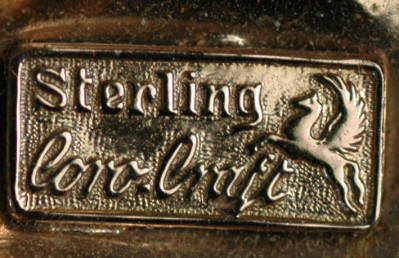
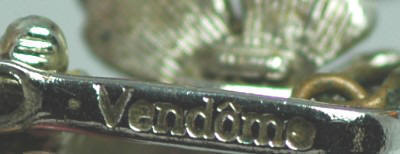
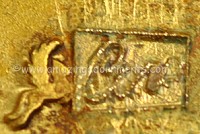
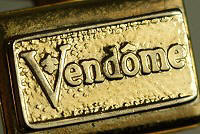
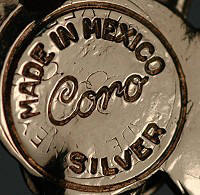
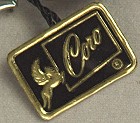
Coro Pegasus Hangtag
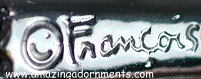
Francois Hallmark was first used in the late 1930s. This was
Coro's first high- end line.
|
|
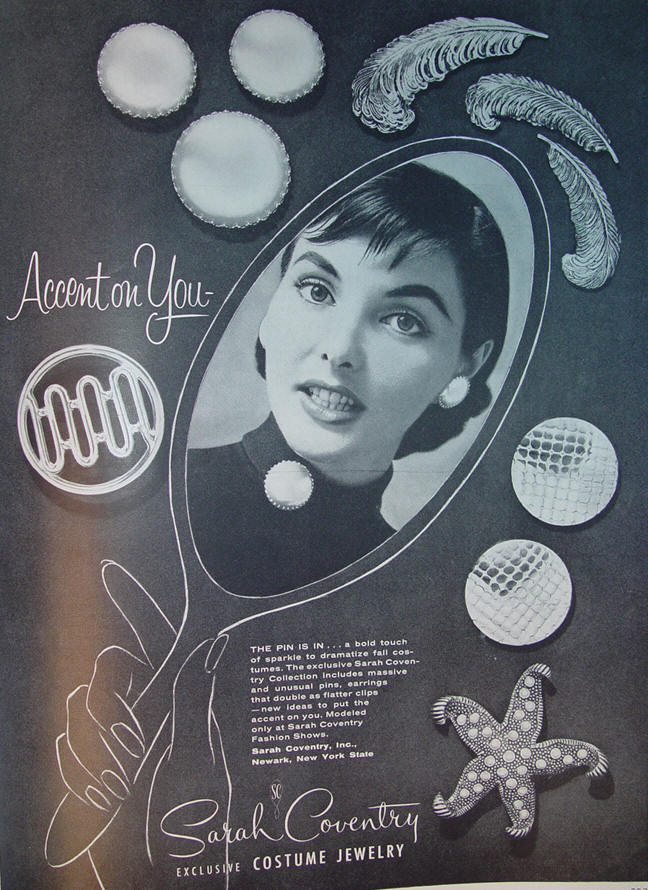
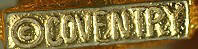
Sarah Coventry |
|
|
Founder (s): Charles H. Stuart as
Sarah Coventry, Inc. Newark NJ, USA ~ 1949- 1984 and again in the early
2000s to Present -Charles H. Stuart founded the
Emmons Jewelers, Inc prior to founding Sarah Coventry, Inc. He named the former
after his wife. He named the latter after his granddaughter. The jewelry was not sold at department
stores, but rather in the home at parties. This was a wonderfully ingenious
idea as it was just after WWII and woman were looking for not only income,
but to keep up with the trend towards accessories. The jewelry for men and women was designed
by outside companies in a variety of styles. Some of the jewelry had
Victorian influences, some were exceptionally well made and most were not
originally low in price. The company became the largest distributor
of costume jewelry and remained so until a change of ownership and the
waning popularity of the home party method of sales. Sarah Coventry catalogues are popular as
they show the names of the pieces and help to date the jewelry. Between the early 1980s and 2002 the
jewelry was not being produced. Sarah jewelry began to show up on the
internet. In 2003 the jewelry began to be sold at home parties once again.
Sarah Coventry jewelry has withstood the
test of time. Some of the pieces are very popular and have a price tag
to prove it. The "Blue Lagoon" set [manufactured by
DeLizza and Elster] "Midnight Magic" come to mind. Sarah Coventry jewelry was marked in many
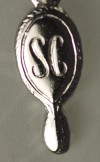
ways and some were not signed at all. Signature Designs/Techniques:
Varied designs and quality. Very elaborate Victorian looks, geometric
Deco looks, simple chains to versatile combination jewelry. From
rhinestones to interesting plastic stones.
Back to top
|
 |
|
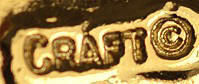
Craft |
|
|
1948-
Gene
Verrecchia of Coro-
Also known as Gem- Craft. His son Ron also
ran the company at one point.
Back to top
|
 |
|
Curtis Jewelry Manufacturing Company |
|
|
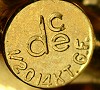
Providence RI, USA - Trademark "DCE" - Makers
of gold filled and sterling jewelry.
Back to top
|
 |
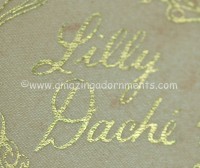
| Lilly Dache |
|
Originally from France she become well known
as a American milliner. She came to America in the early 1920s.
She was also a fashion designer and also made ladies
accessories.
Back to top
|
 |
| Dalsheim |
|
|
Founder (s): Maurice J. Dalsheim,
New York City, NY, USA ~ Late 1930s - 1978? - Founded as the Dalsheim Accessories
Company. The company produced costume jewelry, however it is very rare. Most
of the pieces were unsigned and marked only by a hangtag. Dalsheim costume
jewelry was made with a variety of materials mostly seed pearls, plastic
beads and glass. Due to the amount of unsigned Dalsheim
costume jewelry and the great difficulty in attributing, this jewelry is not
extensively collected. I have seen varying dates for the companies
closure. Techniques:
Seed pearl necklaces, some rhinestones, glass and plastic. In 1951 there
was an advertisement in Vogue for one of their "Bone" necklaces.
Back to top
|
Hallmarks:
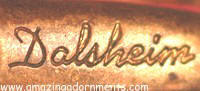
and Dalsheim©
White Jet
Paper hang tags |
|
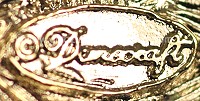
Danecraft
|
|
|
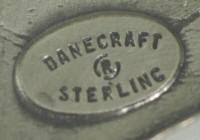
Founders/Owners: Victor
Primavera ~1930s to present. Providence RI- Danecraft was first called Felch &
Company. The "Felch" in the name being James Felch who some have said
co-founded the company with Victor Primavera Sr. In 1945 Victor changed
the name of the company to Danecraft after buying out James Felch.
Victor's son Victor Primavera III came on board as did his daughter
Gail. The company is still a family run business. Danecraft promoted their jewelry to
better department stores. Have current website and their
jewelry is being sold at many department stores. Materials and techniques included:
Sterling silver, vermeil. Jewelry that looks Scandinavian in design. Neat
figurals.
Back to top
|
 |
|
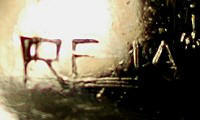
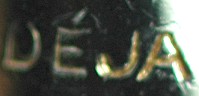
Deja/Reja
|
|
|
Founder (s): Sol Finkelstein as the
Deja Costume Jewelry Company, New York, NY, USA ~ 1939 - 1953 - This company had an interesting history as
far as the name was concerned. Shortly after opening a company called
Du
Jay,
Inc., accused Deja of infringement on their name copyright forcing Sol to
change the name of his company to Reja. The company produced high quality costume
jewelry that is considered highly collectable. Signature Designs/Techniques:
Creative designs, mask pins, florals and figural pins.
Pot metal pieces
with high quality rhinestones.
Back to top
|
 |
|
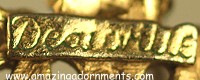
Deauville |
|
|
Founded in 1850 as J.R. Wood & Sons. Jewelry with this
hallmark is rare. The company is still in business producing
class rings and the like as ArtCarved, Inc. They no longer
produce costume jewelry. Back to top |
 |
|
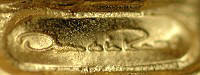
de la Renta, Oscar |
|
|
Founder (s) Oscar Aristides Renta
Fiallo - Oscar was born in the Dominican Republic. He acquired his US
citizenship in the 1970s. At around the age of 18, he went to Spain to
study painting and while there began to concentrate on fashion, we are the
beneficiaries of this choice! Mr. de la Renta has designed exquisite
clothing for several First Ladies as well as Hollywood luminaries. His high-
fashion lines can be found in many upscale department stores. He has
designed for Dior and Elizabeth Arden. In 1965, he began his own
ready-to -wear clothing line. Back to top |
 |
|
de Lillo |
|
|
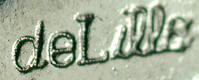
Founder (s): William de Lillo and
Robert Clark New York, NY USA ~ 1967- unknown- This company founded as the House of
William de Lillo, Ltd., was only in business for a brief period of time
therefore the costume jewelry produced is rare in today's market.
William de Lillo was an immigrant from Belgium. Robert Clark worked at
Miriam Haskell and was her chief designer during the 1960s. Clark had
previously worked at Harry Winston and Tiffany's. Known for innovative and very high quality
jewelry made from the best materials including Swarovski rhinestones. At
some point a line of men's jewelry and accessories was designed and
manufactured.
Back to top |
 |
|
DeLizza and Elster
[Makers of The Juliana Line] |
|
|
Founder (s): William DeLizza and
Harold Elster ~ 1947 New York - William's son's Frank and Anthony joined
the company soon after it's inception. In the 1960s the company began
to produce the costume jewelry that so many have come to know and love -
Juliana. These early pieces with colorful rhinestones were not marked in any
way at first. During the early years the company also produced buckles and
buttons and clear rhinestone jewelry. In 1967 Juliana Originals was created and
the paper
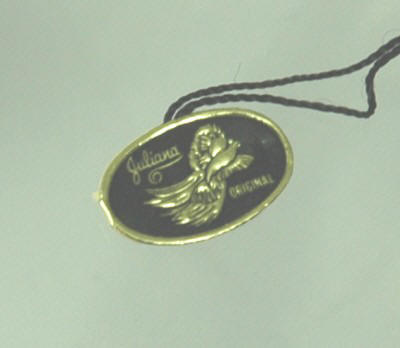
hang- tag made its appearance. The hang tag said "Juliana
Original". Not all Juliana jewelry had a hang- tag. The jewelry had a limited run. But, oh what a
run! Juliana is only one of the lines produced by this company. The company also produced costume jewelry
that had other hang- tags attached. These read, "Tara" and "Gloria".
I believe these were for others rather than their own lines.
Many jewelry companies had their jewelry
produced by D&E including but not limited to the following:
Weiss,
Alice Caviness, Ciro,
Coro,
Kramer, Kenneth Lane, Talbot's, Victoria's Secret, Parklane,
Karu,
Hattie Carnegie and Yves St. Laurent. Some jewelry produced by this
company for others was also unsigned. This is important because, your
unsigned piece could be a D&E! Frank DeLizza is currently producing copies
of some of the old jewelry designs.
To find out more on this fabulous company
please visit:
Discovering Juliana Jewelry
View an article about his soon to be
released book by visiting:
Mr. Frank DeLizza Article
Update- April 27, 2007: The book has been released
and it is a great read! I highly recommend this book for a peek into
the inside of this costume jewelry company.
Update-
January 28, 2010: For another wonderful reference book
you might want to try Juliana Jewelry
Reference Book by Ann Pitman - Several pieces of our D&E
appear in this book. Check out our
blog post for
more information.
Signature Designs: Clear
rhinestone jewelry in the beginning. Large and
colorful rhinestones. Navettes were used a lot, especially the thin
ones. Art glass and other unusual stones.
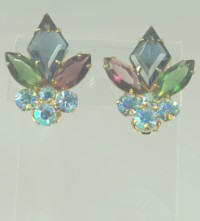
Kite shaped stones, intense
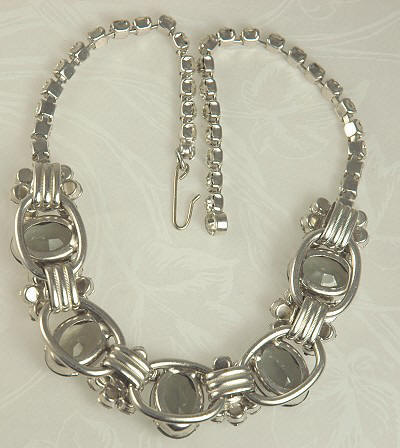
color, five link bracelets and necklaces. Layered designs, and a term
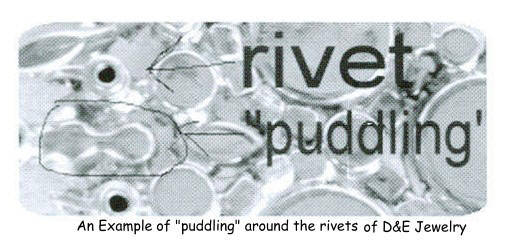
coined by a member of the Discovering Juliana Jewelry Group, "puddling".
This refers to the extra plating that would mound up together
between some of the joints on the reverse of a piece of jewelry.
Back to top
Mary DeMarco |
Click the image for the bigger view.
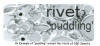
An
example of "puddling". Click the image for
the bigger view.
An Example the
Five Link Construction
Kite
Shaped Stones
|
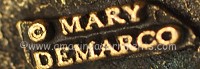
Maryland. Makers of handmade, old world style and whimsical
jewelry and accessories. Semi- precious stones as well as
Swarovski crystals are used. Has been in business for
about twenty years.
Back to top
|
 |
|
Robert DeMario |
|
|
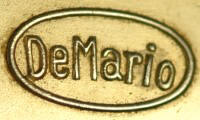
Founder [s]/Owner [s]: Robert
DeMario 1945 - 1960s ~ New York City - Robert DeMario worked for many of the
New York jewelry companies of his day before striking out on his own. He
did not work for Miriam Haskell, however, some DeMario jewelry has a
Haskell
like look. It seems that along with
Eugene
and Stanley Hagler, information about their work at Haskell is false. DeMario had very high standards and it showed in his pieces. It
seems he might have created some pieces for Hagler. It is also known
that a collaboration between the two during the 1960s never happened. His jewelry became recognized for it's superior craftsmanship and the
boldness of his designs. DeMario vintage jewelry is highly
collectable and commands very high prices. Materials and techniques included:
Similar design and techniques as
Miriam Haskell. Layered and sewn beading, filigree backings, seed
pearls and leaves that were intertwined. Very detailed clasps.
Back to top |
 |
|
Denbé |
|
|
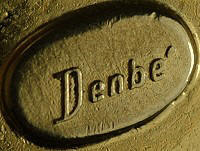
This mark was used by J. J. Denberg of New
York, NY, USA during the 1950s. Date of closure is not known. I have
seen mid 1950s and 1960. All of the pieces I have seen were well made.
Back to top
|
 |
|
Kay Denning |
|
|
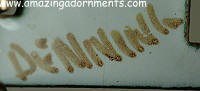
Enamellist. Mod looks on copper.
Connecticut 1960s and 1970s.
Back to top
|
 |
|
DeNicola
|
|
|
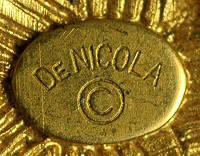
Founder (s): Jerry De Nicola 1957 -
Early 1970s ~ New York City, NY USA -Jerry DeNicola produced jewelry of high
quality meant to rival the real thing. As a matter of fact, one of the early
costume jewelry lines was called "The Real Thing". Now if that did not state
the companies intentions nothing would have! Another line was called "Young America".
This mark was first used in 1964.
During the 1970s, the company became a part of Capri jewelry and the
DeNicola hallmark was not used.
Signature Designs/Techniques:
Bold, large and colorful jewelry that looks close to "real".
Figurals and astrological jewelry as well as Christmas jewelry. According
to several costume jewelry books, this jewelry is highly collectable with
prices to reflect the demand and not so plentiful supply.
Back to top |
 |
|
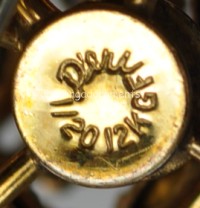
D'eri |
|
1950s
Back to top
|
 |
|
DeRosa |
|
|
Founder (s): Ralph DeRosa, 1935 -
1970 ~ New York, NY, USA -DeRosa costume jewelry is exceptional in
quality and design. The jewelry was often unmarked or marked only with paper
hang tags. DeRosa signed jewelry is therefore rare and will command high
prices. When a piece of DeRosa costume jewelry is signed, the mark could be
difficult to read due to age and wear. This company was a family run operation.
When Ralph DeRosa died in the early 1940s, his wife and his daughters
continued to run the company. DeRosa manufactured jewelry for many
companies including Elsa
Schiaparelli.
Signature Designs/Techniques:
Heavy floral brooches with rhinestones and or enameling. Combinations of
simulated pearls and rhinestones. Unusual designs and choice of stones.
Sterling vermeil.
Back to top
|
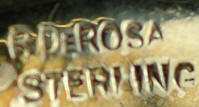
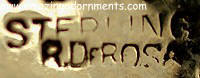
Also: DeRosa imprinted in script,
DeRosa Designed Jewels
and RdeRosa |
|
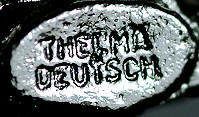
Thelma Deutsch |
|
|
Founder (s): Thelma Deutsch - 1980 to mid
1990s
Back to top
|
 |
|
Diamonbar |
|
|
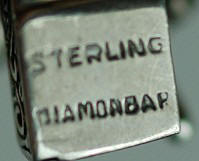
Founded as: Wachenheimer Brothers Inc.
in 1907 ~ Providence RI, USA - This company is well known for their sterling
and rhinestone bracelets, especially the buckle type. These bracelets are
highly sought after and not easy to find! Ceased operations in the
early part of the 1930s.
Back to top
|
 |
|
Dodds |
|
|
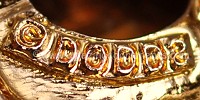
Founded as: Jewel Creations,
Newark, New Jersey, USA ~ 1952-1997- Jewelry by this company, especially the
Christmas jewelry was sometimes produced using kits that sold to aspiring
jewelry crafters. The costume jewelry actually manufactured by the company is
usually of high quality and is not abundant. Sometimes the hallmark on this costume
jewelry cannot be easily read. Signature Designs/Techniques:
Glued in rhinestones of higher quality. Cute figurals. Multicolored stones and
cabochons.
Back to top
|
Also: Dodds or Doddz |
|
Dominique |
|
|
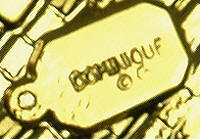
Founder (s): Dominique ?-
Present [Contemporary Designer] - Dominique has been designing jewelry for
many years, however just began signing his jewelry in 1991. His work has
been copied and I suppose that is a form of flattery. Nothing can compare to
the real thing! Dominique designed jewelry for Weiss and
Eisenberg. He is not producing that much jewelry these days and his jewelry
is beginning to become highly sought out. Signature Designs: High quality
rhinestones, staggering beauty, runway jewelry.
Back to top |
 |
|
Duane |
|
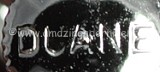
Dates of operation most likely 1950s into the 1960s.
Back to top
|
 |
|
Du Jay |
|
|
Jacques Leff and Jules Hirsch 1934- early
1970s -
Produced fine jewelry at first. This is the company that forced
Deja to change their company name to Reja in the early 1940s.
High quality rhinestone and enamel jewelry, some glass and faux pearls. The
company also used solid gold and sterling. Hard to find jewelry. Jewelry
that is sometimes confused with
Boucher.
Back to top
Duri |
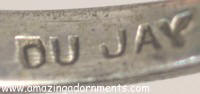
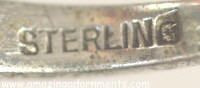
Found on Finger Ring |
Found on contemporary looking pin with
inlay. Could be Duri Jewelry of N.J.
Back to top
|
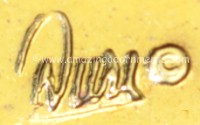 |
|
|
|
|
Stephen Dweck
|
|
|
Founders: Stephen Dweck ~ New York
City- Stephen Dweck is a much respected
contemporary jewelry designer. He studied sculpture and painting in New York City. He launched his first line in 1981 at
Bergdorf Goodman and it was all uphill from there. He was soon designing
jewelry for high profile fashion designers such as Oscar de la Renta, Escada
and Donna Karan. His unique costume jewelry also made it into fashion
magazines and is on permanent display at the Metropolitan Museum of Art in
New York. I have found Stephen Dweck sterling and diamond jewelry selling on
QVC. Signature Designs: Natural
stones, gold and sterling jewelry. Jewelry that incorporates
nature and art. Men's jewelry, belts and china. Back to top
|
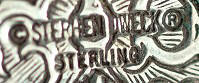
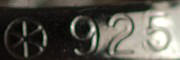
Another mark on some of his one of a
kind designs is a beetle. |
|
Mark Edge |
|
|
Atlanta, GA ~ Early 1980s to
present. Has current website. Mark
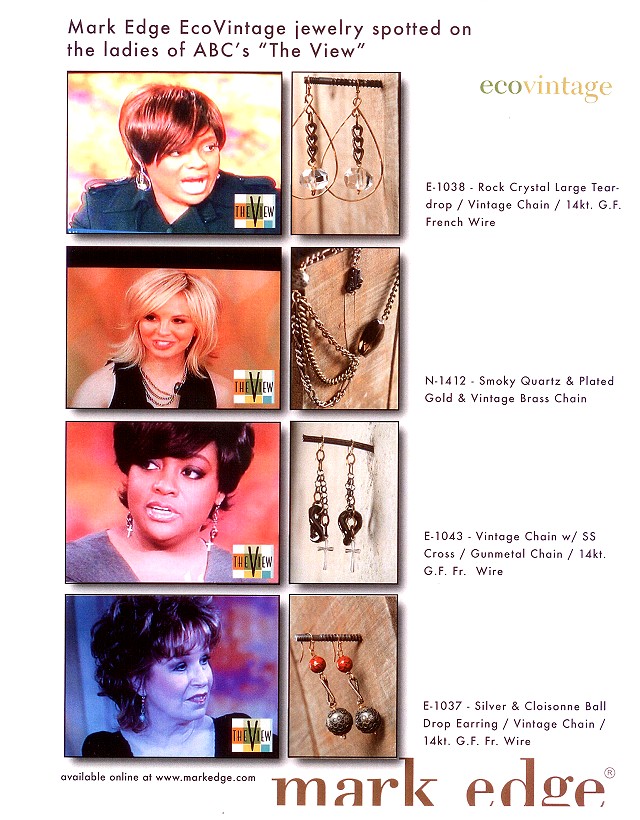
creates hand- made organic jewelry for both men and women. He
has been mentioned as the new “Designer to the Stars”. Courtney
Cox and Vanessa Williams amongst others love his jewels.
Recently introduced a line of “Green” jewelry called “Ecovintage”.
Several ladies from the
View television program have worn pieces from the Ecovintage
line on air. See the promotional ad from Mark Edge below.
The following appeared in the ASSOCIATION FOR THE STUDY
OF JEWELRY & RELATED ARTS [ASJRA]
Newsletter Dated 11/25/2008
NEW ECO-FRIENDLY JEWELRY LINE
Jewelry designer Mark Edge is offering a new eco-friendly
jewelry line titled, “ecovintage.”
These one-of-a-kind pieces are deceptive in their
simplicity and use reclaimed metals and woods, old stock chains
and fittings, and vintage crystals.
The line for both men and women, consists of necklaces,
earrings, and bracelets and “uses environmental conscious
materials, pushing them beyond their conventional uses for a
collection that speaks to the sustainable, ‘less is more,’
fashion of today”, said a company spokesperson.
During the recent eco-renovation of his turn-of-the-century
Atlanta home, Edge found himself inspired by the tarnished brass
and dark stained trim used in the home’s original detailing. For
Edge, reinventing these elements became the foundation of
ecovintage. Just as
his house went from old to new, he gives old charms, pendants,
and crystals an updated look by pairing them with silver and
gold metals.
“Vintage jewelry lines have the potential to look old and worn
out, but I melded the old and new to create a fresh look,” says
Edge. “I designed
my home to last for the next 100 years and have done the same
with the ecovintage collection. Both are timeless and elegant.
More and more people are walking the talk when it comes to
saving the planet and ecovintage lets them do that in style.” Back to top
|
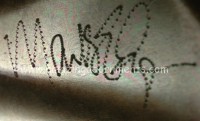

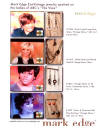
Click on the Thumbnail for the larger image |
|
Edlee |
|
According to the Julia Carroll book,
Collecting Costume Jewelry 202,
this company was listed in the
1954 Jewelers Buyers Guide.
The pieces I have seen are consistent with 1950s looks and
materials. There is no further information about this company.
The jewelry is rare, very well made and most incorporates high
end specialty stones. From this, you can guess it is
expensive if you can find it! Back to top
|
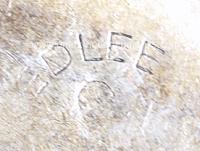 |
|
Eisenberg
|
|
|
Founder (s): Jonas Eisenberg,
Chicago IL, USA ~ 1914 - Present -Jonas Eisenberg was originally from
Austria. He came to the United States in the late 1880s and soon opened a
women's clothing firm. In 1914 Jonas's sons took over the clothing business.
Prior to 1927, the fashions were not created by the Eisenberg company,
rather the designs were "jobbed" out to others. In 1927 the company began to
not only design, but also manufacture the clothing. Eisenberg Original was
born. Like many others, Eisenberg complimented
his fashions with beautiful accessories. The accessories, brooches early on,
were made by others companies. They were crafted with the best Swarovski
rhinestones and soon became very noticed! The son's noticed also and during
the 1930s production and marketing of Eisenberg jewelry began in earnest. Early on the jewelry was not signed as it
was only meant to compliment the clothing. Also the early costume jewelry
produced by the company for sale was marketed separately from the clothing. In the
late 1930s this all changed. The jewelry of these years was marked Eisenberg
Original. In the early to mid 1940s the jewelry was
marketed under the name Eisenberg Ice which became the official trademark of
the company. During WWII, Eisenberg jewelry was produced
in sterling silver. Several marks were used and some are listed or shown
below. In the 1970s the Eisenberg company produced
a line of enamel jewelry designed by well known artists of the time. See pin
below. Eisenberg jewelry, especially the older
pieces are sought out by collectors and rightfully command high prices. Signature Designs/Techniques:
The best of the best in terms of quality and sparkle. Pavé set ribbon or
icing.
Eisenberg Original (squiggly
letters) -- used circa 1935-1945
Eisenberg Original plus the mark sterling -- used around 1943-1948
E [script mark] -- used circa 1942-1945
E. [block print mark] -- c.1942-1945 (may have been used later than
1945 if space for mark was limited). Used again during the 1970s on
the enamel "Artist Series" pieces.
Eisenberg [in block letters] without © -- used from c. 1945-1958
No mark -- during the 1958-1970 period the jewelry was sometimes not
marked.
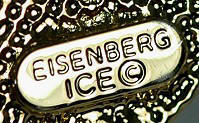
Eisenberg Ice [block letters] with © -- used from 1970 to the
present.
The company still produces new and re- issued jewelry.
Back to top
|
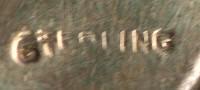
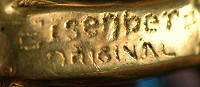
The two marks above were found on the same piece.
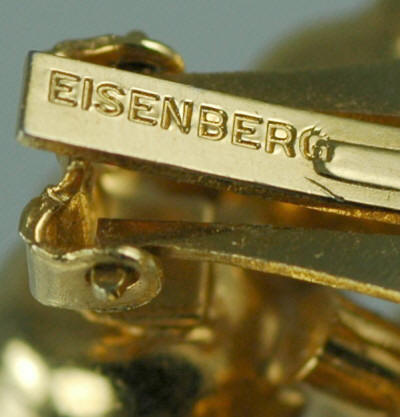
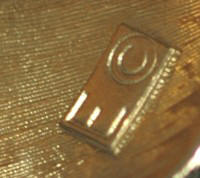 1970s
1970s
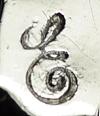 1942-1945
 |
|
Ellen Designs |
|
|
Founder (s): Robert Levy founded the
Fashioncraft Jewelry Company, Inc., in New York, NY USA in 1942. The name
was changed to Original by Robert. In the 1980s came another name change to
Ellen Designs after the then president Ellen Wagman.
Back to top
|
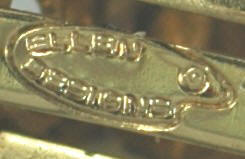 |
|
Elzac |
|
|
Founders: Elliot Handler and Zachary Zemby,
California around 1941. Novelty jewelry made with a
variety of materials including; Lucite, felt, wood, fur and
more. Elliot Handler and others later went on to found the toy
company Mattel. The novelty pieces, mostly people although there
are animals, were very popular during WWII. Popularity waned
after the war. They are currently popular with collectors.
As far as I know, they are all unsigned. Some were patented.
Back to top |
|
|
Emmons |
|
|
Founder (s): Charles H. Stuart as
Emmons Jewelers, Inc. ~ 1949- 1981 -Like Sarah
Coventry, this jewelry was sold at home parties. These parties had become
very popular beginning in the 1950s. Acting as a distributor, Emmons
soon become one of the major players in the costume jewelry industry.
Because Emmons jewelry was designed and made by others, looks and quality
will vary.
Back to top
|

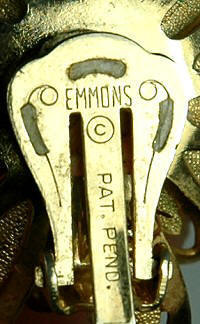
Also: Emmons and Emmolite starting in 1955 |
|
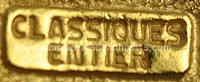
Classiques Entier |
|
A line by the better department store Nordstrom's.
Back to top
|
 |
|
Evans |
|
|
Founder (s): Evans Case
Company- North Attleboro, MA, USA ~ 1920s - This company not only produced costume
jewelry but also produced accessories such as cigarette cases, compacts and
lighters. Their
guilloche
enameled compacts and cases are some of the most beautiful on the market.
Their early costume jewelry was often
enameled and some was done in pastels. Signature Designs/Techniques:
Enameling, pastels colors, gold plated metal and jewelry with a Czech
look.
Back to top |
Hallmark:
Evans |
|
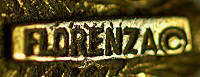
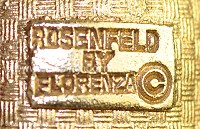
Florenza
|
|
|
Founder (s): Dan Kasoff - New York
City, NY, USA ~ Late 1940s - 1982 -Dan worked at the Speier Costume
Jewelry Company for several years where he learned his craft. He left to
open his own costume jewelry company. His son Larry worked at the company in
several capacities. The name Florenza [after his wife Florence]
was first used in the late 1940s or the early 1950s, however this company was producing costume
jewelry under the name The Dan Kasoff Company prior to this. This company not only manufactured jewelry
for themselves, they designed and manufactured jewelry for many other
companies. Florenza jewelry is distinctive and has an antique look.
It quite often resembles Victorian jewelry, especially the pieces that
utilize filigree. As of this writing, Florenza jewelry is undervalued and
under appreciated in the costume jewelry market. This company also produced accessories for
cosmetics firms such as trinket and pill boxes. These were usually ornate.
very well made and like the jewelry, an interesting combination of stones was
used. Signature Designs/Techniques:
Very well made costume jewelry. Beautiful metal work, usually in
antiqued gold- tone. High quality materials.
Vanity accessories.
Back to top |
 |
|
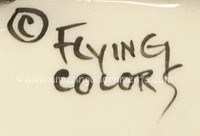
Flying Colors |
|
San Francisco, CA ~ 1980s. Founded by former designers for
Parrot Pearls. Laurie Croft is the artistic director Liz
Corden runs the day to day while Jerry Rush overseas the design.
Bold ceramic jewelry in witty designs and bright colors.
Back to top
|
 |
|
Forstner |
|
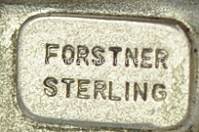
Founded as the Forstner Chain Corp. in New Jersey during the
1920s. Makers of sterling silver pieces. They used several
makers marks. Closed during the 1980s.
Back to top
|
 |
|
Freirich
|
|
|
Founder (s): Solomon Freirich,
France ~ 1900s [I have also seen the date 1920 as the start- up date].
The company seems to have closed in 1990. This company could have been placed in
either the American or European section as it had businesses in both the United
States and in France. The original name of this firm was Maison David and
they manufactured accessories only until around 1955 when they began
to produce costume jewelry. The 1955 date is a best guess. In 1922, Mr. Freirich purchased the company
and changed the name in the United States.
Known
for the buttons they made for Christian Dior and Chanel and for their
antique look jewelry. In fact, their pieces are such good representations of
Victorian jewelry; some has been mistaken for it.
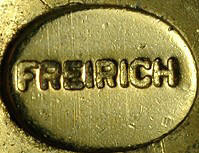
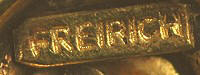
Hallmarks were not used until the 1960s
so the unsigned pieces were being attributed to the wrong period. Techniques/Materials:
Very high quality materials. Handmade. Filigree work. Victorian, antique look.
Back to top |
 |
|
Jolie Gabor |
|
|
Born in Budapest Hungry. There is some
confusion as to her actual date of birth. Her family was in the jewelry
business. Immigrated to the USA in the 1940s to escape the Nazis. She opened
a jewelry shop in New York. She is the mother of the famous Zsa Zsa and also
Eva and Magda. Her jewelry is known for its high quality. It is said that
her daughters often wore it and it would fool experts. Jolie died in 1997.
Back to top |
 |
|
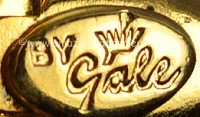
Gale |
|
Mid 1950s, New York ~ High quality
rhinestone and glass jewelry that is not plentiful on the
secondary market.
Back to top
|
 |
|
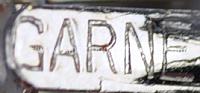
Garne |
|
|
It is widely thought that this company was based in New York.
1945- 1960s??. According to the book
Collecting Costume Jewelry 303 they were in the
import business as early as the 1930s. Not all pieces are
signed. Some were sold on presentation cards.
DeLizza
and Elster, the makers of the popular Juliana line,
produced some of their pieces.
Back to top |
 |
|
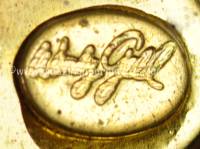
Wendy Gell |
|
|
1975-present. New York. She began producing handmade pieces from
her house. She gathered a following and was soon approached by a
Vogue magazine fashion editor to do a feature. Her pieces sold
in high end department stores. She has produced pieces for
Disney, she has sold on QVC, eBay and she has a current website.
She is the maker of the now famous large cuff bracelets that are
clustered with stones and elements called
"Wristy's". Also of note are
the Wizard of Oz line and pieces from the movie Who
Framed Roger Rabbit. The pieces are usually large and well
made.
Back to top |
 |
|
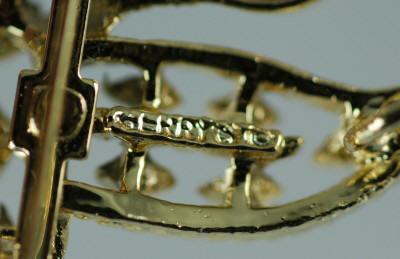
Gerry's
|
|
|
Founder (s): Geraldine
Giles as Gerry's Creations ~ 1950s - either 1996 or the early 2000s [I
have seen both dates several times while researching this company]. New York
City, NY, USA-There is very little information available
about this company, however it seems they must have produced a lot of
jewelry. I come across this jewelry often. I can attest to the widely held
belief that this jewelry is quite common. I read in Fred Rezazadeh's book Costume
Jewelry that several companies used this hallmark. Techniques/materials:
Figurals,
enamel
and Christmas pins.
Back to top |
Gerry's © |
|
Sandor Goldberger |
|
|
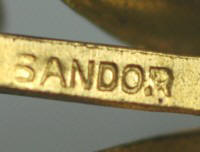
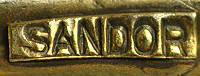
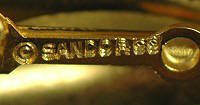
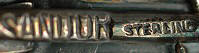
Founder (s): Sandor Goldberger as
the Sandor Goldberger Company New York ~ 1930s - 1972 -Sandor Goldberger began
the company in the
mid- to late 1930s. The company produced high quality rhinestone jewelry and
beautiful life like enamel flower pins. Some of the jewelry was in the
elaborately beaded style of
Miriam Haskell. Sandor designed at least one piece for
Fred A. Block. See the
book A Tribute to America by the Carla and Roberto Brunialti on page 165 and 167.
These pages show and describe and Aztec Mask marked Fred A. Block that was
designed by Sandor. Signature Designs/Techniques:
Enamel florals, high quality rhinestone pieces, sterling florals, antique gold plated
jewelry, Miriam Haskell look faux pearl, bead and coral pieces.
Back to top
|
 |
|
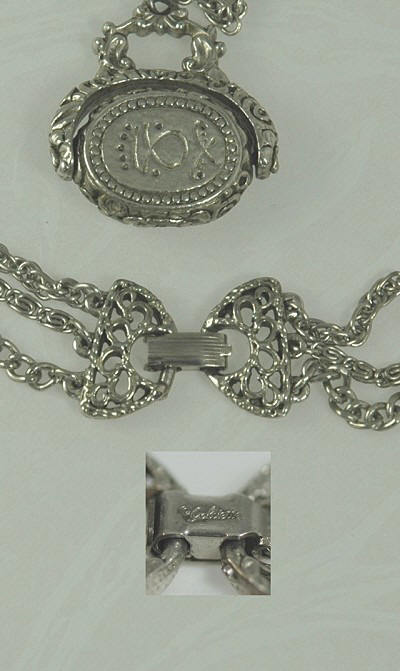
Goldette |
|
|
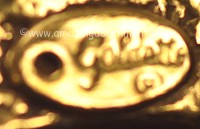
Founder (s): Ben
Gartner as the Circle Jewelry Products- New York City, NY, USA ~ 1958 to
possibly 1977, however this date is uncertain. The Goldette mark was first used in 1958.
This company produced jewelry with designs that were influence by Victorian
and Oriental looks. They also produced Native American look pieces. The necklaces often had several strands and elaborate
clasps. It is possible to find unsigned Goldette
jewelry. You can usually tell if your piece was produced by this firm by
looking at the clasps and the centerpieces. Techniques/materials: Gold-
tone and silver- tone metal, elaborate clasps. sliding charm bracelets,
enamel and colorful stone combinations.
Back to top
|
Also Goldette NYC |
|
R.J. Graziano |
|
|
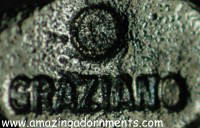
New York - Has been creating jewelry
for about 30 years. Highly regarded for innovative designs and quality. Jewelry sells in major department stores, HSN and can be
seen in fashion magazines. His jewelry is a celebrity favorite and has
graced the red carpet often. Known to use Austrian
crystals.
Back to top
Halbe |
 |
|
New York - Thought to be
in business from the 1950s to perhaps the 1960s. This jewelry is
hard to find. We have seen pavé set rhinestone pieces, some with
enamel and baguettes. The jewelry is usually well made.
Back to top |
 |
|
Stanley Hagler
[Ian St. Gielar and Mark Mercy] |
|
|
Founder (s): Stanley Hagler
1950s to present ~ New York, NY, USA -Stanley Hagler 1950s - 1996 / Mark and
Ian 1996 - Present
Ian St. Gielar [1953- 2007] Sadly, Ian
St. Gielar died of a heart attack on March 21, 2007. His wife
Valentina will continue the business using the name "Ian Gielar Studio".
There is an ongoing controversy regarding
jewelry made bearing the mark of Stanley Hagler since his death. I am trying
to stay out of this while still
providing accurate information. Mark Mercy and
Ian St. Gielar currently both use variations on the Stanley Hagler mark. Stanley Hagler began producing costume
jewelry in the 1950s. His jewelry was unique and well made; however it was
not the colorful Hagler jewelry that came later. It has often
been confused with that of Miriam Haskell. The jewelry was hand wired and he
was known for his choose of the highest quality materials. Mr. Hagler was
also known for his beautiful Russian gold- plated findings and
filigree
backings. I have seen his work described as "wearable art" and the man
himself described as the "Picasso of jewelry." If you see a piece of Stanley
Hagler
jewelry you would have to agree. Through the years, Mr. Hagler built up
quite the clientele including many stars. He also won the Swarovski Design
Award in 1968 for the first of his eleven times. Mark Mercy joined the company in 1979. According to the Vintage Fashion and Costume Jewelry
magazine, Mark took on the work habits of Mr. Hagler. In 1983 the company relocates to Florida.
The hallmark changes from "Stanley Hagler" to "Stanley Hagler N.Y.C.". Ian joins the company in 1989 and becomes
the chief designer. Mr. Hagler passes away
in 1996. Mark and Ian continue to make jewelry in the style of Hagler.
They both design for Hollywood stars, political powerhouses and the like.
Techniques/materials:
Jewelry that like Haskell uses seed pearls and are hand wired.
Hand-blown glass, the best Swarovski crystals, large pieces that are
layered and very intricate. Bold colors, gilt metal and the very famous
Russian gold plated filigree backings.
UPDATE: 2008, Feb 21 - I have had the
opportunity to communicate with Valentina Ian St. Gielar's widow and she has
been kind enough to provide me with some information about her late husband
and the Hagler company. Here are some excerpts of her communication:
Color (as well as volume) was brought into
Hagler's jewelry by Ian, in 1989.
Hagler never retired - he passed most
(and later all) of his duties on Ian.
***"Hagler would never allow anybody to be a "Hagler's designer". He would
never admit that Ian is actually designing his pieces. Same as, I bet, you
don't know that many of earlier Hagler's designs were actually designed by
Roselyn Kaplan of Baltimore (I have a Colorado newspaper with an article on
this). Anyhow, Ian became an exception. There are letters and other
documents"
Back to top
|
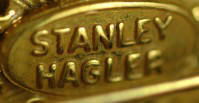
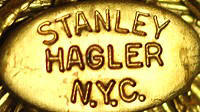
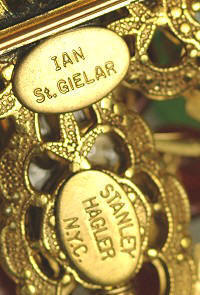
This hallmark is one that was to be used for jewelry created by
both Stanley Hagler and Robert DeMario. The partnership did not
happen but Hagler used some of the findings. It does seem Demario
created some pieces for Hagler using yet another hallmark.
|
|
HAR |
|
|
Founder (s): Hargo Jewelry
Company - Dates unclear, actual name unclear, founders unclear. Well, we know the company existed, based
upon the beautiful and imaginative jewelry showing the mark, however there
really isn't much more information than that. The jewelry produced by this company is of
high quality and workmanship. The Oriental themed pieces are highly sought
after and command above average prices. Techniques/materials:
Genies, oriental themed figural pins, enameled pieces. Dragons and snake
themes. Jewelry with faces. Some use of rhinestones and pearls.
Back to top |
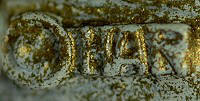 |
|
Miriam Haskell |
|
|
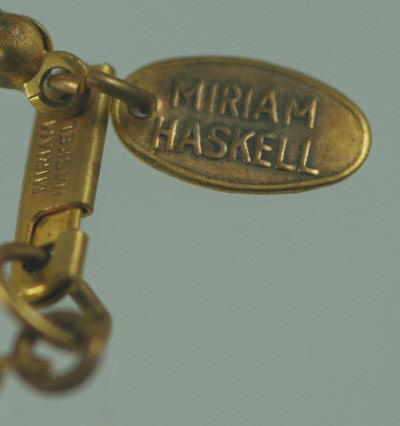
1924-present -Miriam Haskell jewelry is known for
its elaborate and innovative design as well as the attention that
is paid to detail in construction a piece. Miriam Haskell took many
cues from the artists of the
Art Nouveau
period. You can see in her jewelry natural motifs, the
intricate flowers, natural materials and complex construction. These items undoubtedly took a long time
to produce. It is therefore easy to imagine why a Miriam Haskell
item will command such a high price. Miriam Haskell was born
in Indiana in 1899. In her twenties it is said that she
ran a gift shop in New York
City where she began making jewelry with great success. Each piece
was hand made and so elegant she gathered quite the following. Soon
additional space was needed to accommodate her growing success. In 1926 Miriam Haskell goes into
major production. Frank Hess becomes the chief designer. In the
beginning of the 1930s Miriam Haskell establishes retail shops at
Saks Fifth Avenue, NYC and Harvey Nichols in London. Miriam
oversaw all aspects of production. Hess was a creative genius who had
previously worked at Macy's as a window dresser. Most of the jewelry
created at "Haskell" was unsigned at this time. In the late 40s most of the jewelry
began to be marked. Haskell purchased materials from only the best
sources. For example, beads from Italy and France and faux pearls
from Japan. Haskell purchased faux pearls from Bohemia
until the late 30s. After WWII, the faux pearls were purchased from
Japan. In the 50s Miriam retires from her company. Her brother
Joseph takes over and continues to work with Frank Hess on the
"Signature Haskell Look". Joseph sold
the company a few years after taking over. Frank Hess retires in 1960 and
Robert F. Clark replaces him as Chief Designer. Peter Raines also
worked at Haskell during the 60s. Larry Vrba was the chief designer
in the 1970s. Miriam Haskell died in 1981. The Chief Designer was
Millie Petronsio. The company was sold again in 1983 and 1990. It is still in
business today. Buyer Beware: Miriam Haskell jewelry is often
duplicated. Several companies use similar techniques findings and
stampings. When purchasing unsigned Haskell take special note of
construction of the piece and the materials used. Frank Hess was a
perfectionist so any sloppy wire work for example is a dead give
away that the piece was re-stored badly or NOT Haskell.
Materials and techniques included:
Glass beads, faux seed and baroque pearls, gilt metal, elaborate clasps,
filigree backings/stampings and wired construction. Pins had stems that opened
partially. Combination of different types of stones and materials. Haskell jewelry can be simplified down
to a single design motif. This single motif would be embellished when
creating some of the more elaborate jewels. If you are familiar with the
Ready to Wear fashion concept of producing a several lines each season
then you can understand how Haskell jewelry was produced. If not, think
of a simple design motif embellished in different ways thus creating the
several pieces or the "line".
Signature Look: Layered tapestry
type beading [rhinestones, glass, faux pearls] and gold filigree.
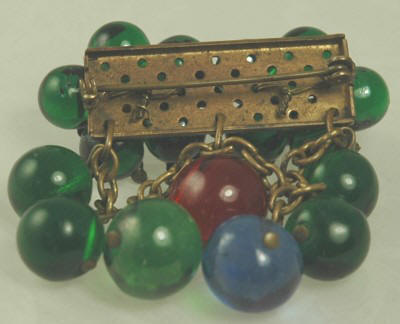
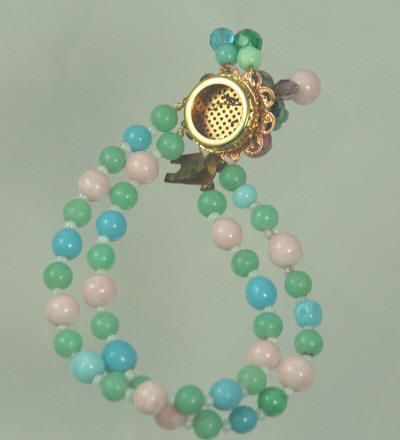
From the unsigned years - Two pieces
that show the wire work.
Back to top
|
Patent for
clasp used starting in 1975 Click on the
Images for a Larger View
Courtesy
of Greg at
www.charlesjoseph.ca
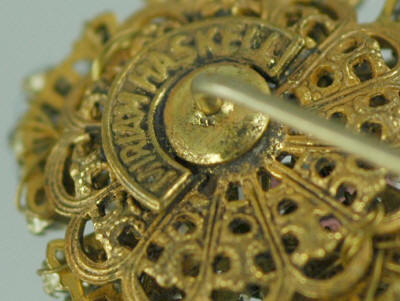
1940s Horseshoe Hallmark
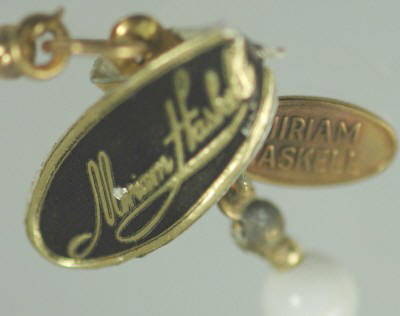
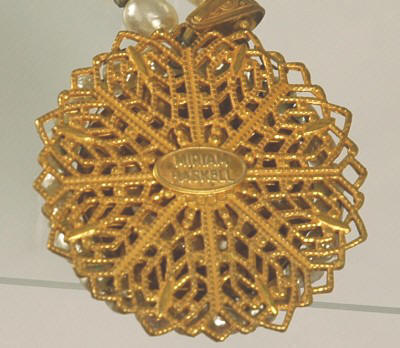
An Early Stamping- Click Image for
Larger View
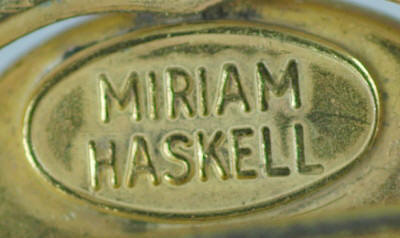 |
|
Hayward |
|
|
|
|
|
Hedy |
|
Hedison Manufacturing Company - 1909 to 1985-
Providence RI - Christmas jewelry. Enamel pieces.
Back to top
|
 |
|
Hobé
|
|
|
Founder (s): Jacques Hobé -
Paris, France ~1887 * William Hobé - United States ~1927- 1995 I have read that the company is still in
business [2006] and being run by sons of William Hobé. While this has been a
company passed down to each male heir, I do not think the Hobé jewelry being
produced today has any relationship to the Hobé jewelry created by the Hobé
Cie jewelry company that the Hobé family began. Jacques was William's father. Jacques
was a skilled craftsman who earned a reputation as a fine jeweler and it is
said he became the royal jeweler to the court of France. William learned the
trade from his father. William immigrated to the United States and
found work selling theatrical costumes in the early 1920s. Soon he was
producing costumes and costume jewelry for the Ziegfeld Follies. In 1927, William opens the American
counterpart of his fathers company
Hobé Cie jewelry company. in the early
1930s, Hobé begins to sell to retail outlets and is becoming a rising star
in the theatrical and film world. Many orders came his way. Much like his
peer Joseff, his jewelry looked authentic and historically accurate. This
was a high profile position and led to many starlets and "super" models [in
today's vernacular] wanting to wear his designs. Naturally this helped his
retail sales. By the 1950s, Hobé was designing for some
of the most famous leading ladies of the day, such as Bette Davis. In the 1960s, William's sons Donald and
Robert begin running the company until the 1980s when a grandson named James
takes over. The company was sold in 1999 or the very early 2000s although the mark
is still in use. Most of the pieces produced by Hobe Cie
were designed by the family During the 1030s through the 1970s. Some of the
pieces during this time frame were designed by Lou Vici who worked as a designer for the company. Beginning in the 1980s William's grandson
takes over operation of the company. Techniques/materials:
High quality costume jewelry using top of the line materials such as
platinum, semi-precious stones and vermeil. Jewelry that looked like the
real thing and utilized some of the same construction techniques.
Reproductions of historical jewelry.
Back to top
|
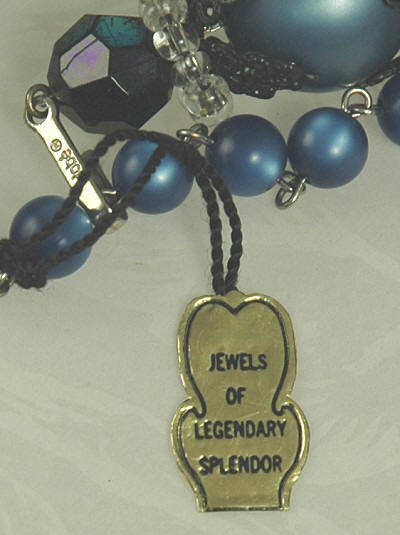
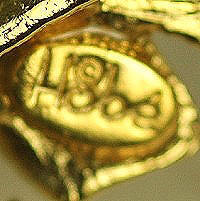
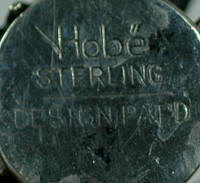
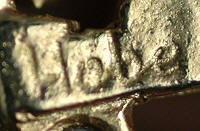 |
|
Hollycraft
|
|
|
Founder (s): Joseph Chorbajian and
others as the Hollywood Jewelry Manufacturing Co. Inc. ~ New York, NY ~ 1938
to about 1971 - Hollycraft jewelry has its own look. It is
well made and very "rich" looking and ladylike. The stones are most often
multi- colored pastel. They always have an abundance of sparkle and depth.
Some of the rhinestone pieces are accented with enamel. The Christmas pins
are very popular. The jewelry was first marked in 1948 and in
1950 the company began dating their creations. The hallmarks often had an
accompanying date. Made jewels for others. Signature Designs: Christmas
jewelry and pastel multi- colored rhinestones. Elaborate settings.
Back to top |
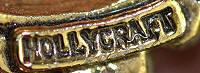
and Hallmark with the Copyright Symbol |
|
JBK |
|
|
At first the only
information we could find about the JBK hallmark was that it
could be either a Hong Kong company with a Huntington
Beach, California location or Jewels by Kevin. I have since
found out, thanks to a customer that this is a hallmark found on
a line of jewelry sold on QVC.
It stands for
Jacqueline Bouvier Kennedy and the pieces are recreations of her
jewelry!
Back to top |
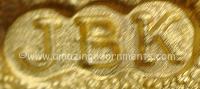 |
|
Norma Jean |
|
|
|
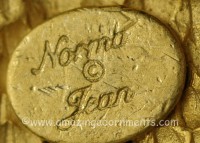
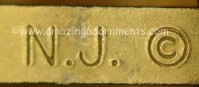 |
|
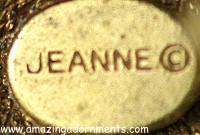
Jeanne |
|
Possibly the New York company founded by Mark Dottenheim.
The jewelry is well designed with quality elements. According to
several costume jewelry books, the figurals are the pieces
collectors look for. Rhinestones and faux pearls are often used.
Back to top
|
 |
|
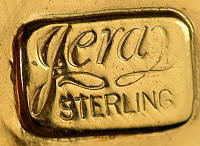
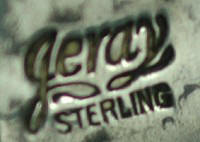
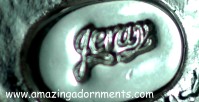
Jeray |
|
This hallmark was used for the first time in
1946 when the original company called
Rice- Weiner split into two companies.
Back to top
|
 |
|
Jewels by Julio |
|
1946 - 1957. Providence RI, Marner Jewelry
Company, Julio Marsella and Ralph Neri.
High quality stones and imported rhinestones. Mesh and beautiful
bead and metal work. Made jewelry for others including Hattie
Carnegie and Hobé.
Back to top
|
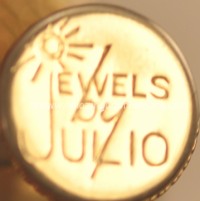 |
|
Ginnie Johansen |
|
|
Dallas, Texas- Contemporary jewelry and accessories designer.
Her pieces are often stamped with the date. She began her
company when in her late teens when she was unimpressed with the
contemporary jewelry found during the mid 1980s.
Back to top |
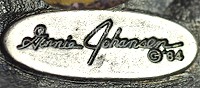 |
|
JJ
|
|
|
Founder (s): Abraham Lisker ~ 1935
Providence RI as the Providence Jewelry Company. Name changed later to
Lisker and Lisker and finally to Jonette Jewelry Company-This company recently [2/2007] announced
that it was closing. It had a second life in the past so maybe there is a
third for this creator of whimsical costume jewelry. It was during WWII that the company [as
Lisker and Lisker] closed it's doors the first time. The restrictions the
United States government placed on metal created shortages for most
jewelers. The company re- opened after the war and Jonette Jewelry became
the trademark. The costume jewelry created here tends to
be quirky, many done in pewter wash. Also known for figural pins and
Christmas pins.
Back to top |
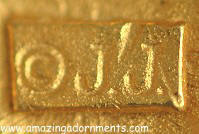 |
|
Jolle |
|
New York -This is the mark used by the
Hess- Appel beginning in the early 1940s. It is believed they
went out of business in the 1950s. The company was established
in 1942 by Lester Hess and Jack Appel. Hess had done some prior
work for Uri Mandle. The company employed at least one more
designer, George Fearn who did prior work with Karu. Many of
their pieces appear in the Brunialti books.
Back to top
|
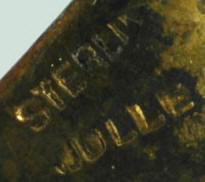
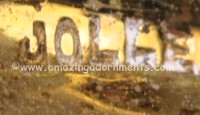 |
|
Jomaz/Mazer Brothers |
|
Founder (s) Joseph
and his brother Louis, New York 1920s as Mazer Brothers. In 1946
Joseph left and formed Joseph J. Mazer Company. The trade mark
was Jomaz. Some early pieces were created by Marcel Boucher.
Louis left Mazer in 1951 but the company did not close until the
late 1970s. Adolfo created some of these later pieces. The
pieces were produced with high quality sometimes special order
stones. It is often described as elegant.
Back to top
|
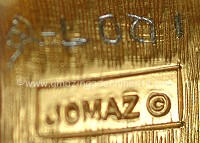
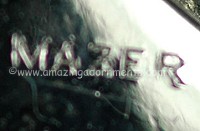
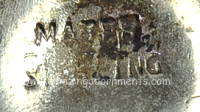 |
|
Joseff of Hollywood |
|
|
Founder (s): Eugene Joseff as
Joseff of Hollywood 1935 - Present -Eugene Joseff was born in Chicago in 1905.
As a young man [1923 to about 1926] he worked at an advertising agency
before he moved to Hollywood in the late 1920s. Once out in Tinsel Town he
pursued his real passion, costume jewelry. He soon became a designer and before long
his pieces were showing up in movies and on the stars off the screen. The
actresses even modeled the jewels in several publications. The
jewelry seen in the movies was leased or rented to the studios. The great starlets seen wearing his jewelry
created a buzz in the general public. Just like today, ladies watching the
movies wanted to emulate the screen goddesses. 1937 or 1938 a retail line was introduced.
Joseff copied his original pieces for this line. It is said that only one
store per city could sell the jewels produced for the public. I guess he
learned something about marketing in his prior career! Joseff is also credited with creating a
type of gold- plating that did not produce as much glare under the lights as
materials being used. It was a semi- matte Russian gold- tone finish. It
became exceedingly popular. Joseff used this plating for his retail line as
well. Joseff became known as the leading supplier
of costume jewelry to the movie industry. Not bad for a self taught jewelry
designer! Joseff died in a tragic plane crash in
1948. His wife, Joan Castle Joseff carried on the business. NOTE: It is possible to find
unsigned Joseff jewelry, however most pieces were signed. Some of the older designs are being
reissued by the Joseff Company for today's market. This is a practice that
several companies follow. Eisenberg is one example. To see Joseff of
Hollywood's current jewelry line and more visit their website,
http://joseffjewelry.com/index.php Techniques/materials:
Authentic period designs. Visually strong pieces. Russian gold plated
pieces. Crystals that were hand cut. Diverse themes and styles [animals
to the zodiac] covering many periods of design. Plastic pieces including
the famous five and six petal flowers.
Back to top |
Older Stamped Mark Joseff Hollywood Dates to
the 1930s - 1940s
|
|
Judith Jack |
|
|
Still in business. The team of Judith and Jack
Rosenberg have a website that explains how they came to sell their wonderful
handcrafted sterling and hand set marcasite jewelry. Their mailing address
is New York City, NY. In business for more than 30 years. The highest
quality marcasites are used and sometimes real pearls and gemstones.
Their jewelry sells at the high end department store Nordstrom's and has
been featured in several fashion magazines.
Back to top |
 |
|
Karu [Aka -Karu Arke] |
|
|
Founder (s): Kaufman & Ruderman,
Inc. 1940s to perhaps the 1970s New York City, NY USA -No one seems to know for certain when this
company closed. We do know that some fine-looking costume jewelry made with
unique stones was produced. Some of the jewelry was unique and made with
antique looking brass. The company used several hallmarks. All
pieces in a set might not be stamped or marked. Signature Designs/Techniques:
Aurora borealis rhinestones, unique stones, antique look
settings/backings. Victorian Revival jewelry.
Back to top |
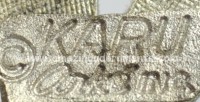 |
|
Tru- Kay |
|
|
Providence RI, 1946 - Moved to
Lincoln RI - Have current website where they sell 14k, gold filled, lockets,
children's jewelry and religious jewelry.
Back to top
|
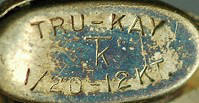 |
|
Kimberlee |
|
I can find no information on this maker as
of this writing. I have seen one set with this hallmark. It was
well- made with rivet construction and a filigree backing on the
brooch. Rhinestones and glass were used.
Back to top
|
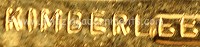 |
|
Anne Klein |
|
Anne Klein was born in Brooklyn NY in 1923. Sadly she passed
away from breast cancer at 50. Along with her husband, Ben she
began her first company focused on young women in the 1940s.
Through the years she won several awards. The Anne Klein
label began in 1968. Donna Karen continued the Anne Klein
and the Anne Klein 11 lines until 1985. The Jones Apparel Group
acquired the brand at one point.
Back to top
|
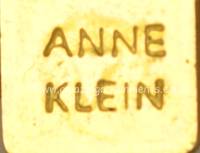 |
|
Alexander Korda
|
|
|
Founder (s): Rice- Wiener ~ Rice- Wiener also manufactured fabulous
costume jewelry for
Barclay and
McClelland Barclay. Best known for the "Thief of Bagdad"
and "The Jungle Book
pieces. These opulent pieces are said to be inspired by the movies directed
by Alexander Korda in the early 1940s. Alexander Korda was born in Hungry in
1863. His given name was Sandor Kellner. Jewelry signed "Korda" and "Thief
of Bagdad" is rare. The jewelry is marked "Thief of Bagdad" as
opposed to "...Baghdad". Many pieces of Korda jewelry have nothing to do
with the movies. These pieces are also not prevalent on the market making
this jewelry prized by collectors. Signature Designs/Techniques:
High quality, bold and elaborate jewelry.
Back to top
|
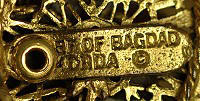
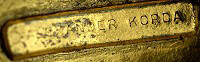
This mark says "Alexander Korda" |
|
Kramer |
|
|
Founder: Louis Kramer, New
York, NY. 1943 to about 1979-
Louis founded the costume jewelry company as Kramer
Jewelry Creations. His two brothers joined the company
that was to became known for quality and superior design. In the 50s
Kramer manufactured or had pieces manufactured for
Christian Dior.
DeLizza and Elster
manufactured some pieces for this company.
Frank Hess,
head designer at
Miriam Haskell
until 1960 also produced pieces for Kramer after leaving
Haskell and dissolving his partnership with Haskell's nephew,
Josef Morton.
These pieces were hallmarked Amourelle and they had that Haskell
look. They date to 1963 and they are very rare. Materials
and techniques included:
Netted rhinestones, artistic jewelry, superior quality, the 50s
"Golden Look" and the 60s "Diamond Look".
Back to top |
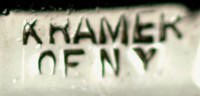
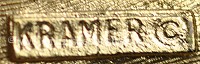
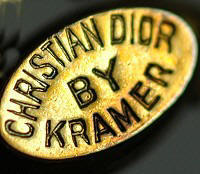
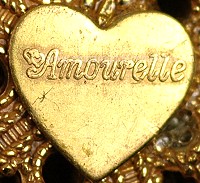 |
|
Krementz
|
|
|
Founder (s): Krementz and Lester
families in 1866. -In the beginning the company produced cuff
links, buttons and other men's accessories. Note that in the ad to the right, cuff
links are being marketed along with their costume jewelry! During the late 1800s, the
company began to produce accessories for ladies. In the 1930s, Krementz
began to produce women's jewelry. Krementz produced fine jewelry and jewelry
that looked "real". The two families parted ways in 1936. During the 50s the company sold a large
amount of costume jewelry. The costume jewelry business was sold in 1997.
The fine jewelry company still exists. A company called Colibri purchased
Krementz (costume jewelry). Colibri closed in 2009. It is thought that
the name was then purchased by an internet company. Signature Designs and Techniques
Used: Developed a technique of 14K and 10K gold plating - a
distinctive overlay process all their own. Delicate jewelry, white and
yellow gold jewelry, use of leaves and roses.
Back to top
|
Hallmarks are often on the pin rods and
very small.
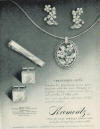

Diana is a line of jewelry produced by
Krementz that sold in department stores such as Gimbels. Pieces with
this hallmark are hard to find on the secondary market. |
|
Kirks Folly |
|
1979- present NYC. Family owned.
Known for whimsical pieces. In 1992 they began selling on QVC.
Have a current website.
Back to top
|
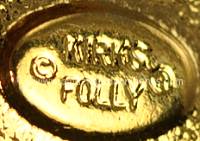 |
|
Amy Lacombe |
|
Contemporary - Los Angles California 1983. Amy
creates handmade ceramic gifts and jewelry. Has current website.
Back to top
|
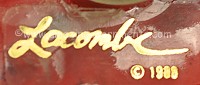 |
|
Laguna |
|
Royal Craftsmen, Inc., New York - Early 1940s.
I found conflicting dates as to when they closed. Some say
during the 1970s while others say the 1980s. Known for well made
crystal jewelry. They also produced pieces using plastic and
sometimes imitation pearls. According to several costume jewelry
books, all pieces in a set are not always signed.
Back to top
|
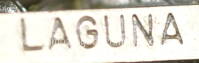 |
|
Walter Lampl |
|
New York- 1921 -1959. Produced fine and costume
jewelry. Wholesaler. Some of the costume jewelry can be found
with semi- precious stones. In 1939 his company produced a heart
charm for the World's Fair held in New York. These
sterling silver charms went on to become treasured by
collectors. The are usually intricately detailed and some call
them mini works of art.
Back to top
|
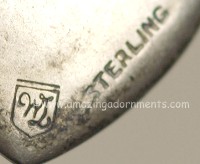 |
|
|
|
|
Kenneth Lane |
|
|
Founder: Kenneth Jay Lane: 1963 -
Present~ Designer of bold, almost always over- the -top costume jewelry. His
costume jewelry is sold in better department stores. Some of the newer
pieces are being sold on QVC. Mr. Lane is a designer to several stars
including Paris Hilton and Britney Spears. Jackie Onassis and Audrey Hepburn
have worn his creations. He and is the author of costume jewelry
books. He was born in Detroit in 1930. He began his career in fashion as a
shoe design director at Delman and later
Christian Dior. His costume jewelry is highly collectable and very
pricey, especially the older pieces.
Back to top
|
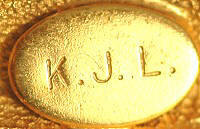
Earliest Hallmark: used during the
early 1960s into the early 1970s. This hallmark is from an early bangle
that also appears in Mr. Lane's Faking It book.
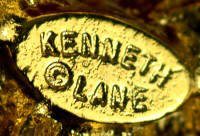
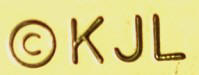
Kenneth Jay Lane ~ Newer
K.J.L. for Laguna
K.J.L. for Avon - Sometimes these
pieces just say K.J.L. and could be confused with the oldest hallmark.
Usually the presentation box will say for Avon |
|
Lang Jewelry Company |
|
Providence RI Mid 1940s to ?
Back to top
|
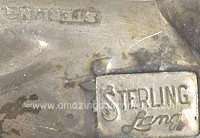 |
|
La Roco |
|
|
Seattle Washington
Back to top |
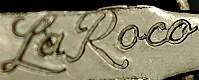 |
|
Ledo and Polcini |
|
|
Founder (s): Italian born Ralph Polcini
began this company as the Leading Jewelry Manufacturing Company in 1911.
Location was New York. The hallmark Ledo was used from the late 1940s into
the 1960s. Sometime during the 1960s the name was changed to Polcini.
At this time Ralph Polcini's son, Damon was at the helm. I am unclear as to
when the company ceased operations. It appears it was sometime during the
late 1970s or 1980s. I have also read that Pamela Polcini, Damon's daughter
continued the company. There is a New York Times article dated October, 1989
announcing her wedding and it also mentions that she was at that time the
design director of the company. Their jewelry is known for its superior
construction and is rare on the secondary market.
Back to top |
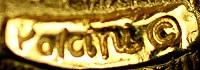 |
|
Judith Leiber |
|
|
The Judith Leiber company launched in 1963.
Judith Leiber emigrated to the United States from Hungary with
her husband in 1947. She studied handbag design in Hungary and
brought the skills with her. Her handbags can be seen in the
hands of some of the most famous movie stars and First Ladies
alike. If you watch the awards shows, chances are most of the
starlets are carrying one of her evening bags. Fine and costume
jewelry was also produced by this company as well as pill boxes,
belts and eyewear. All of the products were produced with the
very best materials and are well made. The prices are quite
high. Pavé set crystals are a signature technique. Although
there is a current website, Ms. Leiber and her husband sold the
company in 1998.
Back to top |
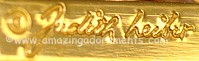 |
|
Judy Lee
|
|
|
Founder (s): Blanche Viano~
Blanch- Ette Company ~ 1950s - 1980s -This company was similar to
Sarah Coventry
and
Emmons in the way that the jewelry was sold. The home party was the
method of distribution. I have read that the Blanch- Ette Company
produced the jewelry. To my eye the quality varied so much that I think some
may have been produced by others. The jewelry was of average to above average
quality, sometimes utilizing rhinestones seen in better costume jewelry. The
backings also utilized such techniques as riveting seen in better costume
jewelry. Signature Designs/Techniques:
Traditional rhinestone jewelry, pretty colors and shapes.
Back to top |
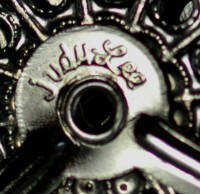 |
|
Lenox |
|
|
Founded by Walter Scott Lenox. New Jersey. Makers of high
quality tableware since 1889. Has commissioned pieces to
the White House. They also market under Dansk and Gorham.
This company also produces giftware, collectables and jewelry.
Have current website.
Back to top |
 |
|
Leru |
|
|
1950s - 1960s Founded as the Pelton and Leru Corporation in New
York. Known mostly for thermoplastic sets. Back to top |
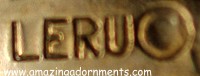 |
|
Longcraft |
|
|
Trademark of The Thomas Long Company. Founded
1946 Boston MA USA. Makers of the Giovanni line as well.
Back to top |
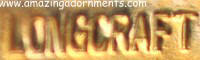 |
|
Lidz |
|
New York 1895 as Lidz
Brothers. Produced novelties, sewing notions, some jewelry
buttons and belts. Many items were produced for costumes. They
used several hallmarks.
Back to top
|
 |
|
Lisner |
|
|
Founder (s): D. Lisner Company New
York City ~ Early 1900s - Mid 1980s- This company produced a wide variety of
costume jewelry during their over 55 years. The jewelry varied in use of
materials, styles as well as quality. Taking a page out of the
Coro
business
model, this company made jewelry for all price points. In fact, some of Lisner's jewelry looks a lot like mid- range Coro
costume jewelry. Lisner also produced some very nice above
average costume jewelry using high quality rhinestones stones and techniques. Their colorful
sets with sculptured plastic stones, usually shaped like leaves, are very
popular. Jewelry made with the oak shaped leaf is most sought after. Although some of the plastic sets were considered low end and still
are, they do not lack quality! The company used several trademarks. A few
included: Crystalia and Junior Prom. The first mark was "Lisner" in block
letters first used in 1938. name "Lisner" [Long "L" and small "isner"] was
first used in 1959. The Lisner name was no longer used on jewelry beginning
in the late 1970s. Lisner purchased Richelieu [the pearl
company] in the mid 1970s. The name was changed to Lisner- Richelieu and
then sold in 1979. Signature Designs/Techniques:
Brightly colored plastic jewelry sets, AB rhinestone sets, molded glass,
multi colored rhinestones.
Back to top |
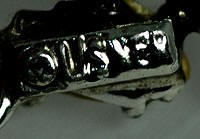
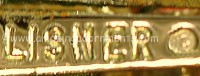 |
|
Little Nemo
|
|
|
Founder (s): Benjamin Brier, Charles
Brier and Samuel Magid as Little Nemo Manufacturing Company 1913- 1978
Provenience RI, USA- There is a bit of a mystery associated with the Little
Nemo mark. First, Little Nemo is not the same company as Nemo. Or is it?
Which company did the above mentioned men actually begin? What does the L/N
stand for? Then there is the way the pieces were marked. LN, LN/25, LN/50
L/N and LN in a diamond. What if anything do these designations mean?
No one to date really knows, however it is thought that the LN mark is the
earliest. The jewelry is high quality and spans many design styles. Some of
the Little Nemo jewelry is geometric Deco in style while other designs are
curvy and antique looking. Little Nemo made several patriotic pieces. Pot
metal was used as well as antiqued gold and silver- tone settings.
Many pieces can be seen with brightly colored rhinestones and in interesting
shapes. Signature Designs/Techniques:
Bright, high quality rhinestones, patriotic jewelry, lovely floral pins,
pot metal settings as well as antiqued gold- tone and silver- tone settings.
Back to top
Lustern
|
|
|
One of the trademarks of the Louis Stern Co. Providence RI 1871
to the 1950s. Makers of watches, watch bracelets, chains and
other items. Usually worked in sterling.
Back to top |
 |
|
Bob Mackie |
|
|
Robert Gordon Mackie. High fashion designer to stars and more in
Hollywood for over 40 years. He has worked with another legend,
Edith Head. First ready to wear line was introduced in the early
1980s. He has won Emmy awards and was nominated for three
Academy Awards for his glittery costumes. Jewelry
and other items were added to his line in the 1990s. Some of his
jewelry and clothing can be seen on QVC.
Back to top |
 |
|
Mamselle |
|
Providence RI- Early 1960s- 1999
Back to top
|
 |
|
David Mandel |
|
New York
1980s- present. Studied design in New York.
Known for oversized pieces much like the famous designer he
apprenticed with,
Larry Vrba!
While working with Vrba he was able to accept commissions to
design his own pieces in his off time. The idea for his own
"The
Show Must Go On"
line was born! The jewelry is all handmade. They are seen on the
runway and on celebrities.
It is possible to find unsigned pieces as
Mr. Mandel did not sign his early pieces.
Back to top
|
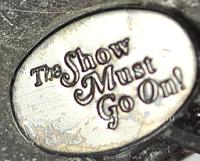 |
|
Robert Mandle |
|
Son of Urie Mandle. Made a series of
musical instrument pins, mandolins.
Robert did work for his fathers
company before beginning his own in 1956. Back to top
|
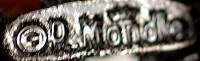
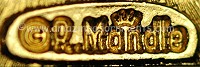 |
|
Urie Mandle |
|
|
Founder [s] Urie Mandle and Nat Levy~
New York~ 1938 - Family was from Germany. Worked at Coro in the stock room
and later in sales. Worked at Lisner where it is said he built the jewelry
line. Began his own company after leaving Lisner. Jewelry is hard to
find. Murray Slater was issued the patents to several of the designs.
Back to top |
|
|
Kandell & Marcus |
|
New York- Information is scarce. Well made pieces on the higher
end in price.
Back to top
|
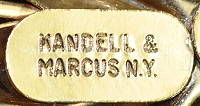 |
|
Marlene
|
|
Providence, RI, USA as the Marlene Costume Jewelry Company.
Sterling Silver jewelry many with a Pirate theme. Other patented
pieces included figurals.
Active during the 1940s.
Back to top
|
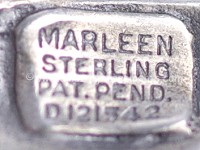 |
|
Marvella |
|
|
Founder [s]/Owner [s]: The
Weinrich Brothers ~ Philadelphia PA ~ 1911 - Present- Weinrich Bros. Co. also had a branch in
New York City. The Philadelphia firm was called H. Weinrich Company. This firm created great looking costume
jewelry that was marked with several different hallmarks. The name
"Marvella" was first used in 1911. In 1950 the name was changed to
Marvella Pearls and changed again in the mid 1960s to Marvella, Inc.
In 1982 the firm was purchased by the Trifari. In the late 80s Crystal
Brands Jewelry Group purchased Trifari. Monet was also a part of this
group. Liz Claiborne purchased the entire group in 2000.
Materials and techniques included:
High quality faux pearls, multi-strand necklaces, faceted beads,
beautiful clasps. Not all pieces in a set were signed.
Back to top |
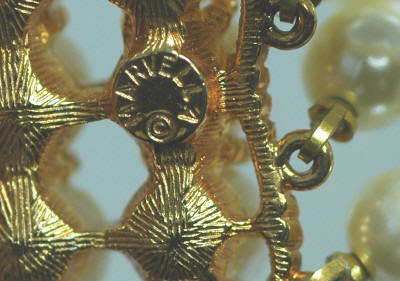 |
|
Matisse/Renoir
|
|
|
1946 - 1964 - Renoir was founded in Los Angeles,
CA in 1946 by Jerry Fells [along with a partner and his brother- in-
law] a native of Brooklyn NY, USA. At first the name of the company
was Renoir of Hollywood. After a fire in 1948 that destroyed the
building they were working in, the name was changed to Renoir of
California. The jewelry created here was inspired by the early 20th
century
Arts and Crafts movement copper designs. Jerry Fells trained at the Arts
Students League and at the National Academy of Design in New York. Fells
freelanced as an Art Director for departments stores before taking a
permanent job at Gertz department store. Jerry Fells joined the Air Force where
he was a fighter pilot during WWII. During the Korean War copper was
scarce. The company began making some jewelry using copper and aluminum.
This jewelry was not very popular. In 1952, Fells opened
another company, Matisse LTD. Here the designs were copper with colorful
enameling. The
jewelry produced here had a "Modernist" look and was inspired by
abstract and expressionists art. Matisse pieces were
more expensive to create because of the use of enamel as you might
suspect. During the 1950s a
line of sterling silver was introduced that was more conservative then
either of their copper lines. This jewelry bore the makers mark "Sauteur
and Sterling". In the 1960s yet
another line was introduced, this time with a brushed gold plated
finish. I have a piece marked "Sauteur" with this finish, however the
mark changed to "Golden Glow" during this time. Materials and techniques included:
Copper and enamel.
Geometric and abstract forms. African inspired, flat and coiled wire
work. The cuff
bracelets and the fringed necklaces command the highest prices in the
vintage collectable market. Sterling and
gold plated designs
made for a limited time during the 1950s and the 1960s.
Back to top
|

Early Matisse Hallmark
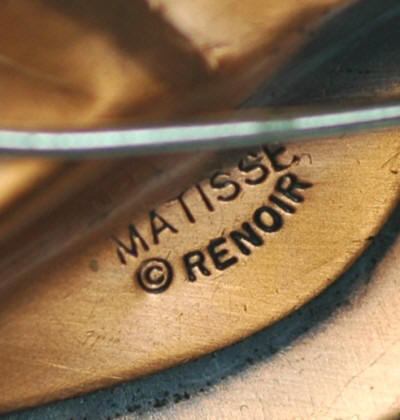
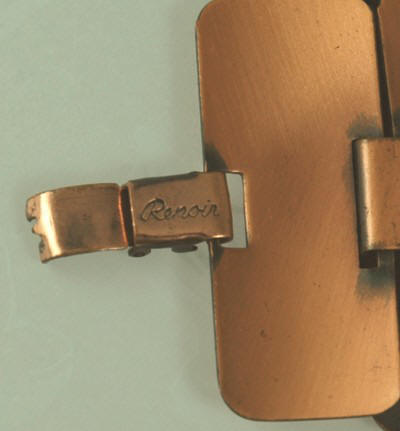
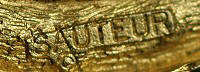
Matisse Renoir 1960s Gold Plated
Jewelry Line Hallmark - Sauteur |
|
Nolan Miller |
|
|
Born in Texas, USA in 1935. Costume
designer for movies and a long, long list of television programs
including Dynasty. In fact, a line of clothing was produced that was
based upon the clothing worn by some of the ladies on that program.
Currently designs jewelry for QVC along with partner Mark Zunnio. That line is
called the "Glamour Collection".
Back to top |
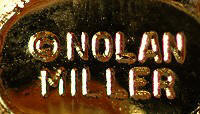 |
|
Iradj Moini |
|
|
Founder (s): Iradj Moini ~
Contemporary- Iranian born jewelry designer Iradj Moini
has created extravagant runway pieces for Oscar de la Renta and other
couture designers. His unique, handcrafted creations are one
of a kind and he utilizes the highest- end imported stones. It is said that
no two pieces are exactly alike. Celebrities are known to love his jewelry
and it has been worn on Sex and the City. His jewelry has been featured at the Louvre. Sold at high end boutiques and department
stores. Recent auctions at Doyle New York saw some
phenomenal prices for this contemporary costume jewelry. Signature Designs/Techniques:
Imported glass stones, super sized brooches, drop dead gorgeous necklaces, one of a kind
jewelry, figurals.
Back to top |
 |
|
Monet |
|
|
Founded by two brothers, Joseph (Jay) and Michael Chernow as Monocraft in
1929, Providence, RI USA. Monet, a Monocraft line launched in
1937. Their jewelry is well made usually in gold or
silver- tone metal. Some did have rhinestones. The jewelry
spanned many decades so the styles varied but the quality
remained. The older pieces,
big necklaces and the charm bracelets are favorites. This
company has changed ownership many times.
Some or most of the contemporary pieces are made in China.
Back to top |
Several Hallmarks including Monet Sterling and Monet in script.
 |
|
Josef Morton
|
|
|
Founder (s): Josef Morton Glasser
and Frank Hess 1960s as Morton Hess-Both of these gentleman had a connection to
Miriam Haskell. Frank Hess was her chief designer from 1926 until 1960 and Josef
Morton was her nephew. It is said the Josef also worked for his aunt
for a brief while. After Frank Hess retired from Miriam
Haskell he joined with Josef to begin Morton Hess. Together they produced
fabulous costume jewelry with beautiful findings and stampings very much in
the style of Miriam Haskell. Signature Designs: High
quality stampings, filigree backings, high quality crystals and beads.
Back to top |
 |
|
Musi |
|
|
Known for shoe clips in both clear and colored rhinestones.
Back to top |
 |
|
Mylu |
|
|
Became a division of Coro
during the late 1960s. Closed during the early 1970s. Best known for
Christmas jewelry.
Back to top
|
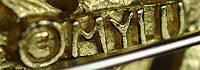 |
|
|
|
|
Jump to Costume Designer History and Hallmark Page Two |
Mystery Marks |